
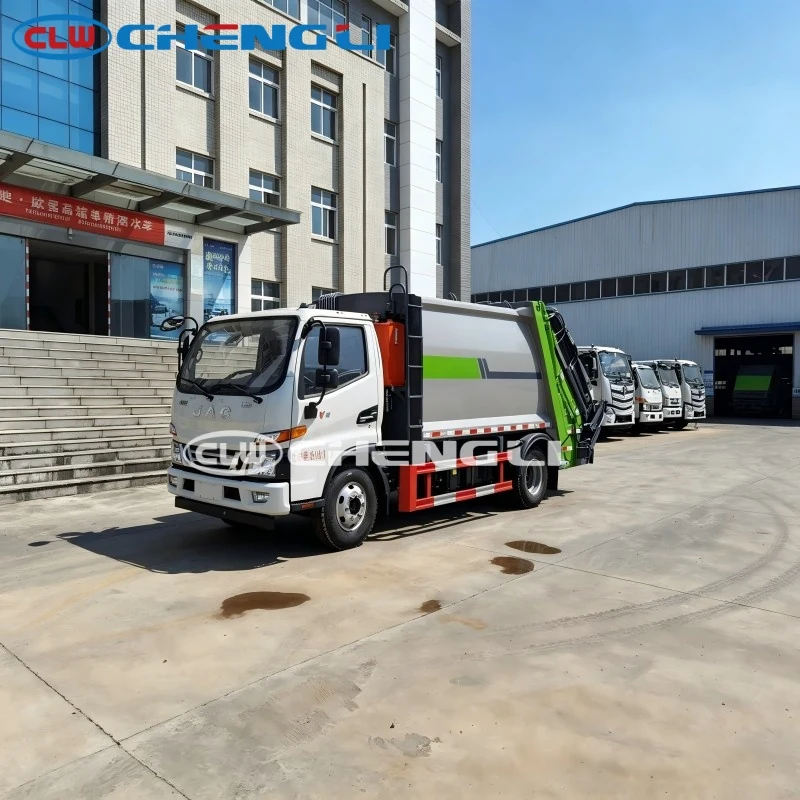
The main choice in this JAC comparison is how you collect waste: fixed-body rear loading or detachable-container exchange. CLW Waste offers two JAC rear-loader compactors, with 8 m³ and 11 m³ bodies, and a JAC electric hook lift with a 106.9 kWh battery. The compactors load waste into a permanently installed body; the hook lift picks up and sets down a compatible box. The three products therefore belong in the same brand guide, but their volume, payload and operating costs must be compared on the correct basis.
Match each JAC configuration to its own chassis, wheelbase, body mounting and mass limits. For a useful comparison, keep the collection task, destination and included equipment consistent between quotations.
Prices are in USD per vehicle. Define the chassis, body, options, container quantity, charging equipment, transport, taxes and delivery terms in the quotation.
1. The three JAC products and their reference prices
| Linked product | Body/container volume | GVW | Power source | Reference price per vehicle |
|---|---|---|---|---|
| JAC 8 m³ Rear Loader Refuse Compactor | 8 m³ | 9,100 kg | Diesel | USD 20,000–23,000 |
| JAC 11 m³ Rear-Loader Compactor Truck | 11 m³ | Diesel | USD 27,000–30,000 | |
| JAC Electric Hook Lift with 106.9 kWh Battery | 11,400 kg | Electric | USD 46,000–51,000 |
For the electric hook lift, select the container by its drawing, hook interface, frame, locks and loaded mass. For the compactors, distinguish body volume from usable waste payload: an 11 m³ body is a volume specification, not a waste-mass rating.
2. Dimensions and configuration details side by side
| Specification | 8 m³ rear-loader | 11 m³ rear-loader | 106.9 kWh electric hook lift |
|---|---|---|---|
| Product detail | JAC 8 m³ compactor | JAC 11 m³ compactor | JAC electric hook lift |
| Collection method | Rear hopper loading and hydraulic compaction | Rear loading and hydraulic compaction | Hydraulic handling of detachable containers |
| Power source | Diesel | Diesel | Electric |
| Drive layout | 4×2 | 4×2 | 4×2 |
| Overall length × width × height | 6,780 × 2,150 × 2,800 mm | 7,390 × 2,500 × 3,100 mm | 5,165 / 5,600 × 2,090 × 2,080 mm; check overall dimensions with the selected container |
| Wheelbase | 3,365 mm | 3,845 mm | 3,300 mm |
| GVW | 9,100 kg | 11,400 kg | |
| Rated payload | 6,455 kg; confirm container-tare and operating-mass basis | ||
| Battery energy | Not applicable to a diesel vehicle | Not applicable to a diesel vehicle | 106.9 kWh |
| Hook pickup height | Not applicable | Not applicable | 1,000 mm |
| Hook centre to rear guide wheel | Not applicable | Not applicable | 3,230 mm |
Dimensions should be checked against the completed order drawings, including mirrors, lifters, hose reels, the selected container and moving equipment. A static length or width is not a swept-path calculation. For a hook lift, the carrier dimensions also do not describe the whole loading movement or guarantee the height of every fitted box.
3. JAC 8 m³ rear-loader: a compact starting point for bin rounds
The JAC 8 m³ rear-loader refuse compactor has a 9,100 kg GVW, diesel propulsion and a 4×2 drive layout. Its 2,150 mm width and 6,780 mm length provide a useful first check where roads and collection points constrain the vehicle envelope. Assess the actual street, parking pattern, hopper access and discharge site before deciding it is the right size.
Its operating model is repeated collection into a fixed compaction body. Plan bin presentation, lifting equipment, crew positions and the packing/discharge process together. The 8 m³ description tells you the nominal body volume; it does not establish how many tonnes of a particular waste stream can be collected.
At a reference price of USD 20,000–23,000, this is the least expensive of the three JAC configurations. These price ranges apply per vehicle; compare the equipment included in each quotation. It is useful when building an initial budget, but the final offer still needs the intended bins, destination, driving position and equipment scope. A lower purchase price does not compensate for a vehicle that needs excessive disposal trips or cannot handle the required pickup interface.
4. JAC 11 m³ rear-loader: more body volume with a larger vehicle envelope
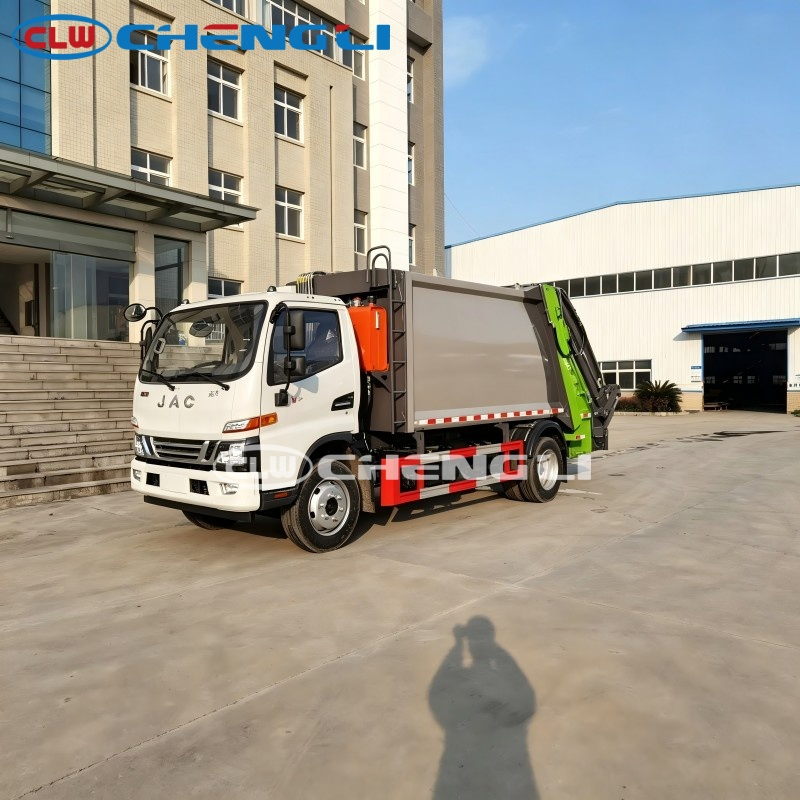
The JAC 11 m³ rear-loader compactor has diesel propulsion, 4×2 drive, a 3,845 mm wheelbase and dimensions of 7,390 × 2,500 × 3,100 mm. The power rating is 132 kW. Keep this configuration separate from the 8 m³ model rather than assuming all JAC compactors share its dimensions or engine specification.
The capacity and compaction guide separates additional body volume from additional usable payload; it provides the calculation behind this size comparison.
Compared with the 8 m³ vehicle, the 11 m³ body has 3 m³ more nominal volume, a 37.5% increase. The complete vehicle dimensions are also 610 mm longer, 350 mm wider and 300 mm higher, with a 480 mm longer wheelbase. Those are comparisons of the stated dimensions, not predictions of turning radius, legal access or daily output.
The larger body can be worth considering where a route currently fills the smaller truck by volume before it reaches a permitted mass limit. It will not automatically carry 37.5% more waste by mass or complete 37.5% more work. Waste density, usable payload, axle loading, stop time and unloading travel can each become the limiting factor.
The 11 m³ compactor is priced at USD 27,000–30,000 per vehicle, above the USD 20,000–23,000 range for the 8 m³ model. Compare complete equipment scope and route requirements. The order specification should identify GVW, curb mass, axle limits and permitted waste payload for the selected build.
5. JAC electric hook lift: a different collection workflow
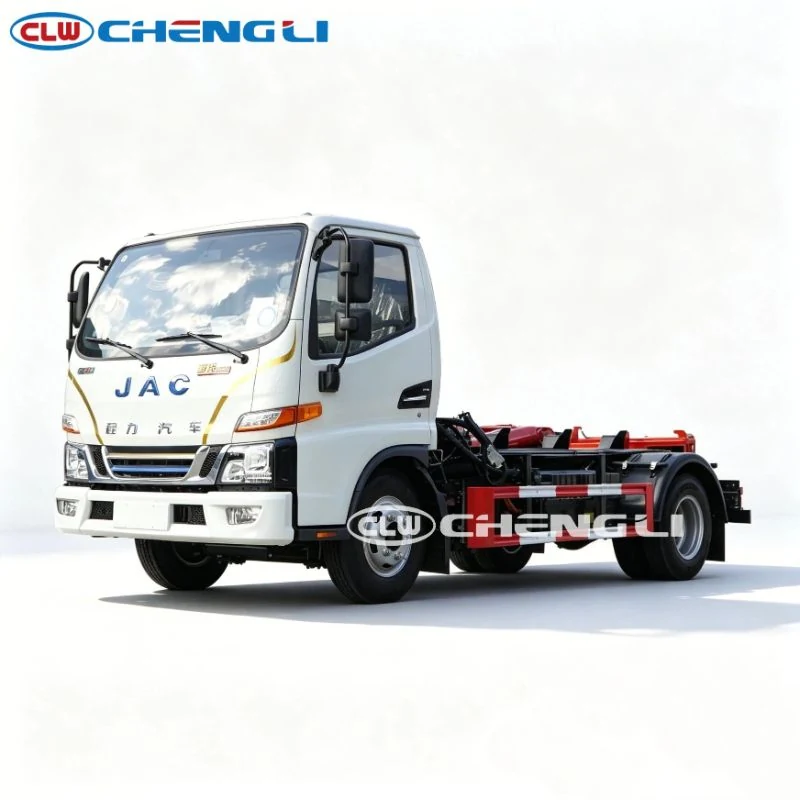
The JAC electric hook lift with 106.9 kWh battery is designed for detachable-container handling. Instead of emptying every bin into a fixed compaction body, it can collect a compatible loaded box and replace or reposition boxes as the route requires. Specify whether the project needs a carrier, a carrier with one box, or a working system with several spare boxes.
Before reusing existing boxes, consult the roll-off and hook-lift comparison to distinguish the pickup mechanism, container geometry and transport load.
This configuration has an 11,400 kg GVW, a 4,850 kg curb mass and a 6,455 kg rated payload. The payload figure is not automatically 6,455 kg of waste: confirm the basis for container tare, occupants, fitted options and operating equipment, and check axle distribution. The hook mechanism's loading capability and the road vehicle's transport limits are separate requirements.
The 1,000 mm hook pickup height and 3,230 mm hook-centre-to-rear-guide-wheel dimension are useful interface references. Send your box drawings and photographs so these can be checked against the exact proposed system. Also identify rail spacing, rollers, locks, container length, empty mass and maximum loaded mass. Similar box volume alone does not establish compatibility.
The reference range is USD 46,000–51,000. Do not compare it with a diesel compactor as though the only change were the powertrain. It also uses a different body-handling system and can require different containers, site space and operating procedures. A fair commercial comparison states exactly which boxes and charging equipment are included.
6. Rear loader or hook lift: compare the daily process
| Decision factor | 8 / 11 m³ rear-loader compactors | Electric hook lift |
|---|---|---|
| Where waste is received | At repeated bin or loading stops into the fixed body | At sites with compatible detachable boxes |
| Main handling process | Bin/hopper loading, compaction and eventual discharge | Positioning, hooking, loading/setting down and locking a box |
| Equipment at the collection point | Bins or another agreed loading arrangement | Compatible box, adequate ground and loading movement clearance |
| What can remain at the site | The collection bins | A box can remain while the carrier serves other locations |
| Unloading plan | Receiving facility suited to the compactor discharge | Box tipping, exchange or another agreed receiving arrangement |
| Energy planning | Diesel consumption and refuelling | Traction plus hydraulic work and a documented charging window |
| A common sizing mistake | Equating m³ body volume with tonnes of waste | Treating hook rating, carrier payload and box volume as the same limit |
For dense household rounds, the fixed-body workflow may fit the established bin presentation and discharge process. For sites that accumulate material into boxes, the hook-lift workflow may let loading continue while the carrier is elsewhere. Which works better depends on stop patterns, container stock, travel distance and the receiving facility, so begin with the collection sequence rather than declaring a universal winner.
The collection and transfer workflow helps place fixed-body collection and detachable-container exchange in the same route plan without treating them as identical jobs.
7. Three practical fleet scenarios
Scenario A: access-constrained municipal rounds
Shortlist the 8 m³ rear loader where its vehicle dimensions are a closer starting point to measured access. Check the bin interface and the room needed behind the hopper. Then calculate disposal trips from actual waste quantity and usable waste payload. A narrow access point is a reason to measure the complete movement, not to select a truck by the word “compact”.
Scenario B: a route repeatedly fills an 8 m³ body
Compare the 11 m³ vehicle where street width, height limits and unloading access permit its larger envelope. Record why the current vehicle returns to unload: volume, mass, shift time or an equipment constraint. More body volume addresses the first issue, but cannot be assumed to remove the other limits.
Scenario C: compatible boxes at several collection sites
Evaluate the electric hook lift where boxes can be loaded independently of the carrier and the depot has a workable charging plan. Count the boxes needed at operating sites, in transit, at the unloading point and held as replacements. Include the time for each exchange and inspect the ground and working clearances. One carrier does not by itself create a complete container-exchange system.
8. What the 106.9 kWh battery figure does and does not tell you
Battery energy describes the energy stored in the battery of this hook-lift configuration. It does not by itself establish a real-world range, a guaranteed shift length or the number of container movements. Loaded travel, gradients, temperature, auxiliary work and the charging strategy determine the daily energy requirement.
Provide the daily route, planned loaded and empty trips, container exchanges, depot dwell time, electrical supply and charging windows. Ask the supplier to define usable energy assumptions, charging equipment and the operating reserve in the proposal. Compare electricity and fuel costs using measured or agreed consumption for equivalent work. Include the planned duty cycle, charging conditions and battery warranty terms in the operating-cost assessment.
9. Build a budget for the complete collection system
| Cost item | Rear-loader project | Electric hook-lift project |
|---|---|---|
| Vehicle reference price | 8 m³: USD 20,000–23,000; 11 m³: USD 27,000–30,000 | USD 46,000–51,000 |
| Collection interfaces | Required bin lifter and agreed bins/loading method | Hook frame and the quantity/type of compatible boxes |
| Site and infrastructure | Bin presentation and discharge access | Box locations, loading clearances and depot charging |
| Operation | Crew, diesel, tyres, maintenance and disposal travel | Crew, electricity, tyres, maintenance, exchange travel and charging time |
| Commercial additions | Freight, duties, inspection, documents, options and support scope | The same commercial checks, plus charger/installation and box-supply scope |
Use the same quantity, destination and delivery term when requesting prices. Ask what the unit price includes and whether containers, freight, charger, inspection, training or initial spare parts are separate. CLW offers quantity-based pricing and phased delivery for larger orders; specify the fleet quantity and required batches so the commercial offer can address them.
A useful first operating-cost calculation adds vehicle payment or depreciation, energy, labour, scheduled maintenance, tyres, collection equipment and site costs for the planned workload. Divide by the tonnes or completed collections actually achieved under that duty. Dividing the purchase price only by body volume overlooks differences in workflow and site equipment.
10. What to send for an accurate JAC quotation
- Identify the starting product: use the 8 m³ compactor, 11 m³ compactor or 106.9 kWh hook-lift link, and state vehicle quantity.
- Describe the material: waste type, measured daily mass/volume, moisture and collection frequency.
- Show the interface: bin pickup details for a compactor, or box drawings, tare mass, hook/rail/lock information and loaded mass for the hook lift.
- Define the route: width and height restrictions, loading positions, gradients, daily distance and unloading location.
- Define the working shift: stop or exchange counts, collection time, travel, queueing, discharge and charging/refuelling windows.
- State the destination requirements: driving position, required vehicle specification, documents and acceptance arrangements.
- Set the commercial scope: currency, trade term, freight, inspection, included options, boxes, charging equipment and delivery batches.
Use the product links in the comparison tables to identify the proposed builds, then request a configuration quotation. The chassis comparison library brings the brand comparisons together.
Questions buyers ask
Which JAC garbage trucks are compared here?
The JAC 8 m³ and 11 m³ diesel rear-loader compactors and the JAC electric hook lift with a 106.9 kWh battery. Product links provide the specifications and price range for each configuration.
How much do the three JAC configurations cost?
Per vehicle: USD 20,000–23,000 for the 8 m³ compactor, USD 27,000–30,000 for the 11 m³ compactor and USD 46,000–51,000 for the electric hook lift. The quotation defines configuration, quantity and commercial/delivery scope.
Does the 11 m³ JAC compactor carry 37.5% more waste than the 8 m³ model?
Its nominal body volume is 37.5% greater, but that is not a payload or productivity guarantee. Waste density, usable payload, axle loads, collection time and unloading travel determine actual work per shift.
What container volume fits the JAC electric hook lift?
Choose the container using its drawing, dimensions, tare and loaded mass. Match the hook, rails, rollers, locks and working clearances to the complete carrier configuration.
What is needed to check an existing hook-lift container?
Send the container drawing, dimensions, tare and loaded mass, rails, rollers and locking details. The hook pickup height is 1,000 mm and the hook-centre-to-rear-guide-wheel dimension is 3,230 mm; match these interfaces to the container and selected equipment.
Is the electric hook lift simply an electric replacement for a rear-loader compactor?
It changes both propulsion and collection method. A rear loader collects into a fixed compaction body; the hook lift exchanges compatible containers and needs a container-stock, site-clearance and charging plan.