
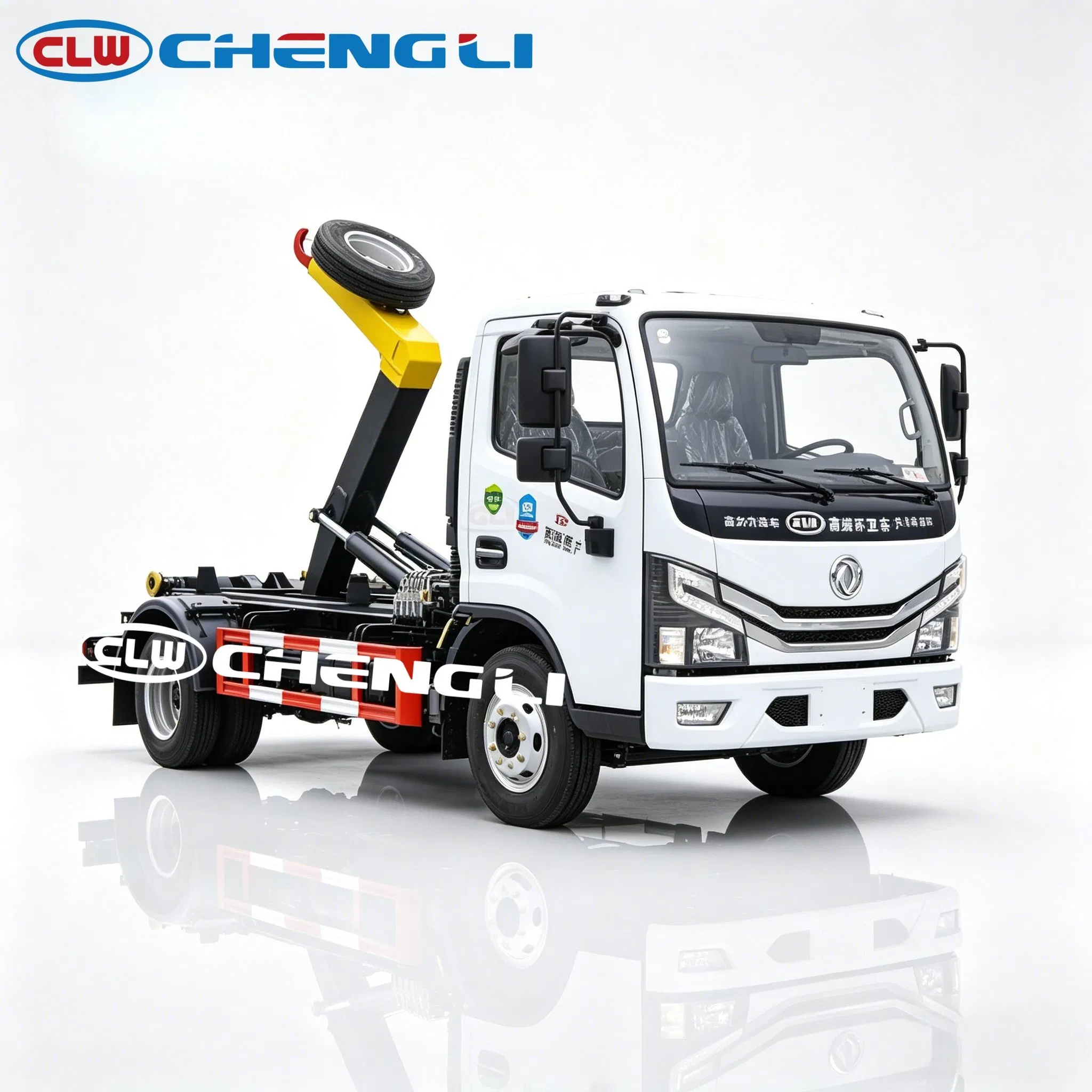
Does roll-off mean a cable system or a hook system?
Roll-off describes removable-container transport broadly enough to cause purchasing confusion. In North American equipment catalogues, the phrase often accompanies cable hoists. Elsewhere, a buyer may use roll-on roll-off or RoRo for a container truck with a hydraulic hook. The commercial name alone is therefore an incomplete specification, even when both offers show a waste container on a truck.
Start by asking how the container engages the handling equipment. Is a cable arrangement drawing it along the hoist, or does a rigid hydraulic hook arm engage its lifting point? Obtain a drawing identifying that arrangement. CLW’s hook lift truck range concerns the hook-equipped vehicle; do not interpret the comparison below as a cable-hoist availability promise.
What is the main mechanical difference?
A cable system transfers pulling force through its cable arrangement. A hook system engages a purpose-designed container pickup point through a rigid arm. Both need a suitable container, support geometry and transport-securing arrangement. Their movement paths and connection details are equipment-specific. Neither name defines a universal container dimension, payload, lifting angle or permissible operating slope.
One manufacturer’s cable-hoist catalogue and separate hook-hoist catalogue illustrate the distinction in terminology. Those are examples of two equipment families, not CLW specifications. Do not transfer their capacities, control features or regional compliance statements into a CLW order. Compare the actual proposed unit and its matched container instead.
How should buyers compare the two arrangements?
Use the following questions to compare the scope of offers. They identify the required evidence rather than rank one mechanism above the other. The same type of hoist can have different container ranges, locks and mounting requirements. A clear drawing and complete mass statement are more useful than treating a catalogue family name as proof of interchangeability.
| Purchase point | Cable roll-off arrangement | Hydraulic hook arrangement |
|---|---|---|
| Container engagement | Cable connection and pulling arrangement specified for the unit | Rigid hook and matching container lifting point |
| Support and guidance | Container rails, rollers and supports matched to the hoist | Container rails, rollers and supports matched to the frame |
| Transport restraint | Stops, locks or other restraints defined for the assembly | Locks and restraints defined for the assembly |
| Loaded mass | Container plus contents, within equipment and vehicle limits | Container plus contents, within equipment and vehicle limits |
| Working envelope | Measured for the actual loading and tipping movements | Measured for the actual loading and tipping movements |
| Buying decision | Existing containers, site and whole operating cycle | Existing containers, site and whole operating cycle |
Can an existing roll-off container fit a hook lift?
Not simply because both containers roll at the rear or have similar external volume. The pickup point, support rails, rear rollers, length and transport locks must correspond to the selected handling system. A cable attachment point is not automatically a suitable hook pickup. Similar-looking steelwork does not establish the strength or geometry required for another lifting arrangement.
Number each existing container and provide its dimensioned drawing, empty mass and intended loaded condition. Record repaired or modified interfaces separately. Use the hook lift and skip container compatibility guide to organize these details. Any proposed conversion needs its own engineering assessment; an adaptor or altered pickup must not be assumed to preserve lifting and transport capacity.
Is lifting capacity the same as waste payload?
No. The handling system moves the container together with its contents. The complete truck also carries the hoist, mounting structure and other fitted equipment. A stated equipment lifting capacity cannot replace the vehicle’s permitted gross mass, individual axle limits or payload calculation. Increasing container volume may add empty mass and length without adding any permissible waste load.
Ask for the mass definitions used in the quotation and the proposed loaded weight distribution. Establish whether a quoted empty vehicle mass includes the container. Otherwise its mass may be omitted or counted twice. The chassis and body matching guide links these questions to wheelbase, mounting and the complete vehicle rather than comparing a bare chassis with a finished truck.
Which system suits the containers already in your fleet?
An established container pool makes compatibility an operational purchasing priority. List which containers must remain in service, where they are exchanged and which vehicles currently move them. A replacement truck should be assessed against those actual interfaces. Selecting only by cubic capacity can create a fleet in which some containers have no compatible carrier when a vehicle is unavailable.
The JAC compactor and hook-lift comparison shows this purchasing distinction within one brand: its rear loaders collect into fixed bodies, while the electric hook lift handles compatible detachable containers. Compare the whole collection system, including the container stock.
For a new operation, define the waste stream, receiving facility and site access before selecting both carrier and container. Keep the interface description consistent across the order. Future container purchases should refer to the agreed drawing and revision, not an informal name. The hook-loader working-principle article explains the hook arrangement before a detailed equipment comparison.
Will one arrangement always complete more trips?
No reliable universal trip advantage follows from the name. Count driving, site access, exchange, securing, unloading, queues and return travel. A loading movement is only part of that cycle. Compare vehicles on the same route, load and receiving arrangements. A quicker isolated demonstration can still lead to the same daily throughput when travel or unloading queues dominate the shift.
For illustration only, assume 360 minutes available for complete rounds. A measured 90-minute round permits four rounds; a 120-minute round permits three. These are hypothetical scheduling figures, not cable-versus-hook performance claims. Include breaks, site restrictions and necessary checks in the available time. Use actual operating observations before purchasing against a promised number of daily collections.
What site space does container exchange require?
Separate road access from the working area. A truck may pass a gate yet lack space to align with a container, transfer it onto the frame or tip at the destination. Measure the actual loading and unloading envelopes, including overhead obstructions. Record ground condition, gradient, pedestrian movement and neighbouring activities; a parked-container footprint does not represent the entire exchange area.
Agree a site assessment using the selected equipment’s instructions and the intended work method. Do not choose an arbitrary clearance or slope from another model. The UK HSE waste-transport guidance highlights route assessment, pedestrian separation and reducing reversing. Those planning principles do not certify a proposed CLW truck for a particular site or country.
How do waste type and unloading method affect the choice?
Describe what enters the container and how the receiving facility accepts it. Bulky materials, dense loads and wet waste raise different questions about capacity, doors, containment and discharge. The lifting mechanism does not by itself determine whether a container is suitable for that material. Specify container construction and load retention together with the vehicle and the destination’s actual requirements.
Distinguish depositing an entire container from tipping its contents. A facility accepting one method may not suit the other. Ask how doors, covers and restraints interact with the specified unloading arrangement. If a compactor container is involved, treat its compacting function, power and interface as separate equipment requirements; a hook or cable hoist is not itself a waste compactor.
How should LHD or RHD enter a roll-off enquiry?
State destination and driving position explicitly. Also define the intended operator position, access and visibility at the exchange site. Moving a steering wheel is not a complete specification for a waste vehicle. Control layout, lighting and the working side should be considered with the chosen chassis and equipment, without assuming every configuration is available in both forms.
The full RHD build guide and LHD/RHD buyer’s guide set out the related questions. Agree destination-specific requirements for the actual order. Traffic side and steering position do not establish import eligibility, registration acceptance or a particular certification. Keep those checks separate from the name roll-off or hook lift.
What should a comparable quotation include?
Ask each supplier to identify the complete vehicle, handling system, compatible container range and included containers. Compare transport restraints, mounting scope, operating documents, training scope and inspection arrangements on that same basis. Separate optional equipment from the base order. Do not compare a bare hoist price against a finished vehicle-and-container package or assume missing items are included free.
Evaluate the purchase together with container replacement, maintenance access and the route plan. Ask which instructions and parts identification accompany the selected equipment; do not assume a universal maintenance interval. See the RoRo bin lorry guide for bin-size and exchange-planning questions. Neither terminology nor a photograph establishes warranty duration, delivery time or a guaranteed operating saving.
What should you send CLW for a hook lift quotation?
Send destination, vehicle quantity, waste description, container quantity and each container drawing or dimensioned photograph. Include empty and loaded container mass, hook or pickup details, rails, rollers, locks, access restrictions and intended unloading method. State driving position, chassis preference and destination requirements. Identify existing containers individually so their compatibility can be considered without silently treating them as identical.
Request a matched waste-container truck quotation with that brief. Ask CLW to define the proposed vehicle and hook equipment together, including the compatible container scope. The practical answer to roll-off versus hook lift is therefore a clear equipment description: name the mechanism, match its interfaces and assess the whole vehicle on the work it must perform.
Questions buyers ask
Is every roll-off truck a cable truck?
No. Roll-off is used for removable-container transport, while cable and hook identify different handling arrangements. Ask for the actual mechanism and container interface rather than relying on a regional name.
Can I put a cable roll-off container on a hook lift?
Only if the complete container and handling system are compatible. Pickup geometry, rails, rollers, length, locks and loaded mass need assessment. A cable connection is not automatically a hook lifting point.
Which is faster: a cable hoist or a hook lift?
Compare measured complete cycles on the same route and site. Exchange time alone excludes travel, securing, queues and unloading. No universal daily-trip advantage follows from the mechanism name.
Does a roll-off container volume state the truck payload?
No. Volume measures space. Permissible load depends separately on container mass, handling capacity, complete vehicle mass and axle limits. Establish what the quoted empty mass includes before calculating waste payload.