
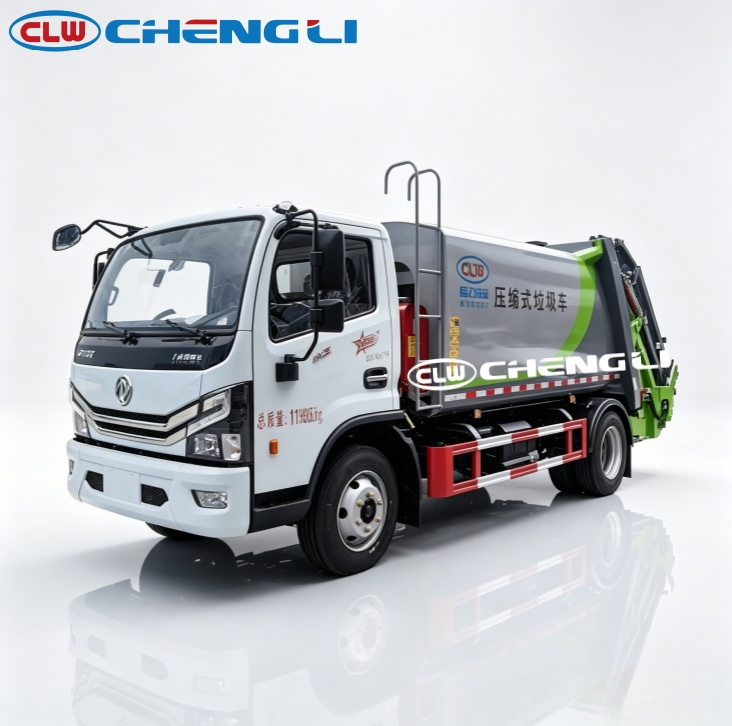
Which capacity figure answers the purchasing question?
Start by separating nominal body volume, usable filled volume and permitted waste payload. Cubic metres describe space. Kilograms or tonnes describe mass. The loading mechanism has its own compatibility and capacity requirements. One large number on a quotation cannot describe all three aspects of a complete collection vehicle.
Decide whether the operation empties bins into a compactor or carries a detachable container. A body-volume comparison can help organise the options, but it does not establish what the mechanism can lift or what the truck can legally carry. The collection method and actual waste load must be specified together.
What does a real CLW configuration establish?
A Dongfeng electric compactor configuration has a nominal body volume of 9.5 m³, a gross vehicle rating of 11,995 kg, a curb mass of 6,900 kg and a rated payload of 4,965 kg. These are different specifications for one configuration. The payload is 4.965 tonnes; it is not 9.5 tonnes because the body holds 9.5 m³.
For a wider set of published configurations, use the Dongfeng vehicle comparison and Foton mini and Auman comparison. Read each product’s own volume and mass figures rather than transferring a payload from another vehicle with similar body size.
Use the rated payload with the complete vehicle's definitions and requirements. For the calculation below, the usable filled volume is deliberately assumed to be 80% of nominal volume: 9.5 × 0.80 = 7.6 m³. That fill percentage is an illustrative planning input, not a promised usable-volume rating or operating output for the truck.
How can the same nominal body reach different load masses?
The relationship is mass = filled volume × bulk density. Density must describe the material in the same condition as the filled volume. Dividing kilograms by 1,000 converts the result to tonnes. The table uses four hypothetical densities without assigning them to household, food, construction or any other real waste stream.
| Assumed density (kg/m³) | Assumed filled volume (m³) | Volume-based mass (t) | Mass-only load ceiling (t) |
|---|---|---|---|
| 100 | 7.6 | 0.760 | 0.760 |
| 300 | 7.6 | 2.280 | 2.280 |
| 600 | 7.6 | 4.560 | 4.560 |
| 800 | 7.6 | 6.080 | 4.965 |
At the highest assumed density, the volume calculation gives 6.080 tonnes, which exceeds the example payload. A 4.965-tonne mass ceiling corresponds to approximately 6.21 m³ at 800 kg/m³, before any additional limitation. Every table result remains subject to actual ready-to-work mass, axle loads, equipment limits and material suitability; it is not a guaranteed collected load.
Why may usable volume differ from nominal body volume?
Nominal volume describes the body or container specification. The practical filling condition depends on waste shape, distribution, loading arrangements and the equipment's intended operation. A nominal volume should not be treated as a promise that every material fills every space evenly or that the same fill condition is achievable on every route.
Define what the capacity includes. Ask whether a stated value refers to the main body, a hopper, a container or a combination. Do not add separate compartments or temporary loading spaces to transport capacity without an applicable definition. Keep the same volume basis when comparing two offers or working through an operating estimate.
What does a compaction ratio actually mean?
A volume-based compaction ratio compares the volume of a defined quantity of loose material with its volume after packing. For example, an entirely hypothetical 3:1 ratio could mean the same retained material occupies 30 m³ before packing and 10 m³ afterwards. If that material weighs 3 tonnes and none is lost, it still weighs 3 tonnes.
This ratio is not a multiplier for permitted payload. It also does not prove that every waste mixture reaches the same packed density. Ask which material, moisture condition, measurement method and packing conditions define a proposed ratio. Compare the compactor range around the intended waste and loading interface, rather than buying only the highest ratio in a headline.
Do not apply both a packed density and an extra compaction multiplier to the same filled volume. That counts the volume reduction twice. If a density was measured before packing, keep the loose-volume basis with it or establish the packed density for the actual filling condition. Label each input so another buyer or operator can reproduce the calculation without guessing which state it represents.
How should different waste streams enter the comparison?
Describe the material before applying a density. Particle size, moisture, packaging, contamination and segregation can change the actual load. A household refuse sample is not a substitute for measured food-waste or mineral-material data. Nor does a mass calculation establish that a particular body is appropriate for an abrasive, reactive or otherwise incompatible material.
| Material or collection characteristic | What to establish | Vehicle or interface question |
|---|---|---|
| Light or bulky dry material | Actual bulk condition and required segregation | Does the proposed body and loading method suit it? |
| Mixed refuse | Composition, moisture and repeatable load measurements | Which compactor and bin interface are appropriate? |
| Wet organic material | Actual mass, containment and unloading needs | Is the proposed body suitable for this stream? |
| Dense mineral or construction material | Loaded container mass and material suitability | Is an appropriate container carrier required instead? |
For dense or containerised loads, compare an appropriate hook lift or skip loader against the specified container and lifting requirements. This is a choice of collection system, not permission to put any material into any truck. The material and complete equipment combination need to be suitable for the intended duty.
Which mass limits can reduce the usable waste load?
Check the complete vehicle's gross limit, its ready-to-work mass, rated payload and individual axle loads. Include fitted equipment and operating items according to the adopted mass definitions. On a container carrier, the container's own mass is also part of the load being handled and carried; its entire capacity is not available for waste mass.
The weight and axle-load guide explains why gross-minus-curb arithmetic alone is insufficient. A volume-based estimate must be checked against each applicable mass and equipment constraint. If an axle reaches its limit first, unused nominal body space does not create permission to continue loading.
How can an operator obtain a useful density input?
Measure representative loads using a known volume basis and suitable weighing arrangements. Record the waste stream, condition and whether the volume is loose or packed. Deduct the relevant vehicle or container mass on the same definition. Repeat across the operating conditions that matter, rather than relying on one unusually dry or unusually heavy load.
Keep these measurements distinct from a prediction for a new truck. Changes in collection method, moisture, segregation or equipment can change the filling condition. Use measured data to establish a defensible planning range, then review the proposed vehicle with the supplier and fleet team. Do not turn a convenient density assumption into a guarantee.
How does capacity per trip become capacity per day?
Multiply a feasible load per trip by the feasible number of trips in the shift. Determine trips from the whole operating cycle: collection, travel to the unloading point, waiting, unloading and the return or repositioning journey. A short packing-mechanism cycle does not describe this complete route cycle.
Use the compactor size guide and fleet calculator to organise those inputs. Check both waste mass and collection time. A larger body may help where volume is the constraint, but it cannot shorten a distant unloading journey or remove access restrictions. Compare alternatives on the same shift and route assumptions.
When does a larger nominal body fail to solve the problem?
A larger body is not automatically a larger usable load. Dense material can make payload the constraint; restricted streets can make access the constraint; and the available shift can make time the constraint. Identify which limit is actually controlling output before moving to another nominal size.
Compare the loading interface, complete dimensions and destination requirements as part of that decision. If bins do not match the lifter, or a container does not match the carrier, additional volume does not solve the incompatibility. Review the collection system as a whole and keep the proposed equipment revision with the operating assumptions.
What should be recorded in a capacity comparison?
Keep one working record for each proposed configuration: nominal body or container volume, the assumed usable fill, the material's density condition, calculated load mass, rated payload, axle assessment and equipment limits. Add route-cycle time and shift duration when comparing daily output. This makes the limiting assumption visible instead of hiding it behind a single capacity claim.
Include LHD or RHD and the required collection side. The full RHD build guide and LHD/RHD buyer guide cover the related layout questions. Driver and operator arrangements belong to the complete configuration, even though steering position by itself does not determine body capacity.
What information should accompany a CLW capacity enquiry?
Send the destination, vehicle quantity, waste description and available mass and volume measurements. Explain bins or containers, collection frequency, route restrictions and the unloading location. Provide the shift duration, expected trips and LHD or RHD requirement. Identify which figures are actual measurements and which are planning assumptions.
Request a garbage truck configuration that connects body volume, collection equipment and usable payload to the duty. Ask for the relevant complete-vehicle specifications and definitions. A useful capacity proposal shows how the vehicle fits the operation, rather than treating cubic metres, tonnes and compaction ratio as interchangeable selling points.
Questions buyers ask
Can I convert cubic metres to tonnes with one fixed factor?
No. Multiply the filled volume by the bulk density in the same loose or packed condition, then convert kilograms to tonnes. The density and actual vehicle limits must suit the intended operation.
Does a 3:1 compaction ratio triple the permitted payload?
No. A volume ratio describes the change in occupied space for a defined material. It does not increase the vehicle’s gross limit, rated payload, axle limits or equipment capacity.
Why can a 9.5 m³ body reach its weight limit before it is full?
The mass depends on density and actual filling condition. In the illustrative high-density scenario, the volume calculation exceeds the example’s 4.965 t rated payload; mass and axle constraints must take priority.
Does the calculation table show which truck can handle construction rubble?
No. The densities are hypothetical and are not assigned to named waste streams. Material suitability, container design, lifting equipment and complete-vehicle limits must be checked separately.