
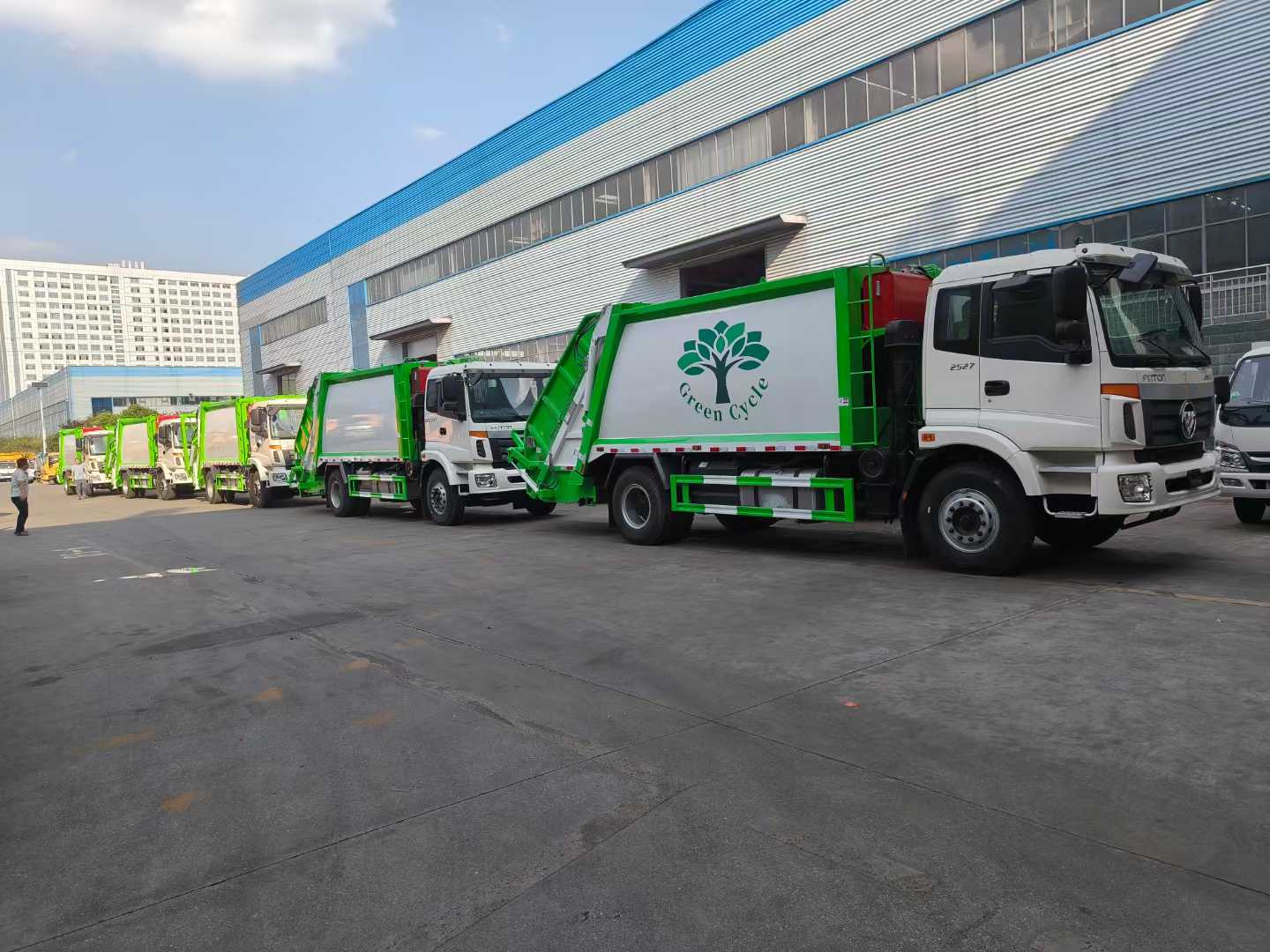
What does the size of a compactor lorry actually describe?
Compactor lorry, refuse lorry and garbage compactor truck can describe the same general collection family. A body capacity in cubic metres identifies a volume. It does not specify how much waste the complete vehicle may carry, how quickly the collection route can be completed or whether the bin lifter fits existing containers.
For a useful comparison, record three separate quantities: nominal body volume in m³, available waste payload in t and complete-vehicle dimensions in mm. Then add the number of workable collection and unloading cycles. Start with the CLW compactor range, but compare the proposed complete configurations rather than treating a capacity label as a full specification.
Can population be used to estimate daily collection demand?
Population is an input, not the answer. Multiply the people within the defined service boundary by a locally measured daily waste-generation rate. Then apply the share actually collected by the proposed service. Keep commercial waste, separately collected materials and other services consistent with that boundary so that the same tonnes are not counted twice.
As an illustrative scenario, assume 100,000 people, 0.7 kg of relevant waste per person per day and an 80% collection share. Generation is 70,000 kg/day, or 70 t/day; the proposed service handles 56 t/day. These are chosen calculation inputs, not rates that should be applied automatically to a city. Replace them with the project's own measurements.
Use collection records and weighing data where available. Check seasonal and busy-day variation, and define whether the total refers to a calendar day or a working collection day. A system that collects fewer days than waste is generated must still handle the accumulated material. Averaging a week's tonnes without considering the timetable can undersize the working fleet.
How do you convert tonnes into required body volume?
Use density at the relevant stage of the operation. For a compactor body, the calculation needs an appropriate loaded density, not the loose volume of bins along the street. In the example, assume 450 kg/m³, equivalent to 0.45 t/m³. Dividing 56 t/day by 0.45 t/m³ gives about 124.4 m³ of loaded waste per day.
Now allow for the usable share of nominal volume. At an assumed 90% planning fill, the nominal body-volume throughput needed is approximately 138.3 m³/day: 124.4 divided by 0.90. This allowance is a planning choice, not a promise that each body can or should be filled to that level. Material behaviour and the actual mechanism still need assessment.
Do not apply a compaction ratio again if the selected density already represents compacted waste. That would count the same effect twice. The guide to body volume, tonnes and compaction ratio explains this distinction and why measured mass is essential for a purchase decision.
How do 6, 8, 10, 12, 16 and 20 m³ compare in one calculation?
The table holds density, fill and trips constant so that the effect of volume is visible. It also applies a separate hypothetical 5 t available-waste-payload ceiling to every candidate. This common ceiling is only a numerical comparison; it does not state that all these body sizes share a chassis or have a 5 t rating.
| Nominal body | Volume-derived mass per trip | Mass after 5 t ceiling | Working trucks needed |
|---|---|---|---|
| 6 m³ | 2.43 t | 2.43 t | 8 |
| 8 m³ | 3.24 t | 3.24 t | 6 |
| 10 m³ | 4.05 t | 4.05 t | 5 |
| 12 m³ | 4.86 t | 4.86 t | 4 |
| 16 m³ | 6.48 t | 5.00 t | 4 |
| 20 m³ | 8.10 t | 5.00 t | 4 |
The mass per trip is the smaller of volume-derived mass and available payload, subject also to axle and operating limits. Working trucks are the daily tonnes divided by that trip mass and by three trips, rounded up. For the 10 m³ example, each truck moves 12.15 t over three trips; 56 divided by 12.15 is 4.61, so five working trucks are required.
The 16 and 20 m³ examples show the value of the separate mass check. Both reach the chosen 5 t ceiling, so the larger volume does not reduce the working count. Changing the actual chassis, density, payload or trip count changes the result. None of the figures is a guaranteed fleet performance or a catalogue availability statement.
Which chassis class belongs to each body size?
There is no universal one-to-one mapping from body volume to chassis class. The complete body, lifter and other equipment consume part of the vehicle's mass allowance. Wheelbase, axle loads, body mounting and load distribution must also correspond. A larger volume mounted on an unsuitable chassis does not create additional usable payload.
For a concrete size reference, the CLW5120ZYSBHJ 9 m³ configuration has a gross vehicle mass of 11,995 kg and overall dimensions of 7,530 × 2,360 × 3,000 mm. These are that configuration's figures, not a template for every 9 m³ truck. Gross mass is not waste payload, and parked dimensions are not the loading or unloading envelope.
Specify the required waste mass per trip before comparing chassis proposals. The chassis and body matching guide covers the information needed to assess a complete configuration. Avoid assigning an assumed lifting capacity or waste payload from the model's volume alone.
How many daily trips can the route really support?
A cycle includes collection, travel to the receiving facility, queuing, discharge and travel back into service. Breaks, inspections and other planned non-collection tasks also consume shift time. The three trips in the table are an assumption to test against this complete cycle, not a standard operating rate.
For example, 420 minutes available for cycles and a measured 120-minute complete cycle allow three whole cycles with 60 minutes remaining. This arithmetic does not show that every area can achieve the same cycle. Longer queues, slower collection or a different unloading site may reduce the count. Recalculate before compensating with a larger body.
When is a smaller body the better purchase?
A smaller complete vehicle can be worth examining where measured access or the collection pattern restricts a larger proposal. Check width, height, turning space and the equipment's working area, not merely the name mini or compact. A low body volume does not prove that a particular lane or gate is accessible.
Also account for the extra unloading visits that a smaller usable load may require. Where a collection vehicle transfers material to another vehicle or facility, include that handoff in the time and equipment plan. A good smaller-truck decision demonstrates both access and sufficient daily throughput; it does not rely on appearance alone.
What changes when bins, waste or the powertrain change?
The body size must work with the collection interface. Existing bin drawings, loaded masses and presentation positions matter, as do loading-side obstructions and the receiving facility. Dense material may reach a mass constraint early, while light material can fill the available space first. Separate waste streams may require separate handling decisions.
An electric proposal still needs the same volume, payload and access assessment. Add driving and body-work energy demands, the charging window and charging facilities. Do not infer range from body volume or assume an electric and diesel build have identical available payload. Compare their complete configurations against the same daily service brief.
How should reserve vehicles and peak days be included?
The table estimates working vehicles only. Reserve capacity must be an explicit operating decision covering maintenance, breakdowns and workload variation. Do not silently add a universal spare percentage to every project. State the downtime assumptions and the service level that the reserve is meant to protect.
Test a busy day, a slower unloading cycle and a lower usable payload separately. This makes the limiting factor visible instead of hiding all uncertainty in one large truck. Use the fleet calculator with your inputs and the city fleet planning guide to document the working and reserve requirements separately.
Where do LHD and RHD fit into size selection?
State the destination and required driving position alongside the route and loading side. A suitable body volume does not settle the cab layout, body-control positions or bin presentation. The complete RHD build guide and LHD/RHD selection guide help define those requirements. Availability and destination requirements apply to the specific chassis-and-body proposal.
What should you send for a correctly sized compactor quotation?
Send CLW the country, vehicle quantity, daily waste tonnes, waste description, density assumptions, collection frequency, route restrictions and receiving-site details. Include bin dimensions or photographs, desired LHD or RHD, chassis preferences and specified emissions requirements. Distinguish measured inputs from planning assumptions so that alternative sizes can be compared on the same basis.
Attach a simple worksheet showing tonnes per working day, usable payload per trip, achievable complete cycles and reserve requirements. Identify which proposals fail access or axle checks before comparing purchase prices. Request a compactor lorry quotation with this brief; the useful outcome is a complete vehicle matched to the collection task, rather than the largest nominal box.
Questions buyers ask
Can a 20 m³ compactor always replace two 10 m³ trucks?
No. Available waste payload, axle limits, route access and achievable cycles can prevent that substitution. Compare daily tonnes moved by the complete vehicles, not just the sum of body volumes.
How many tonnes can a 10 m³ compactor carry?
Volume alone does not determine tonnes. In the illustrative calculation, 10 m³ at 90% fill and 450 kg/m³ represents 4.05 t. The actual vehicle must have sufficient available payload and remain within its axle and operating limits.
Is population enough to choose the truck size?
No. Add the locally measured generation rate, collection share, service frequency, loaded density, route cycle and complete vehicle limits. Weighing and operating records are preferable to a population-only estimate.
Does the calculated working-truck count include spare vehicles?
No. The example counts vehicles working on the daily task. Reserve vehicles and peak-day provision require separate, explicit operating assumptions.