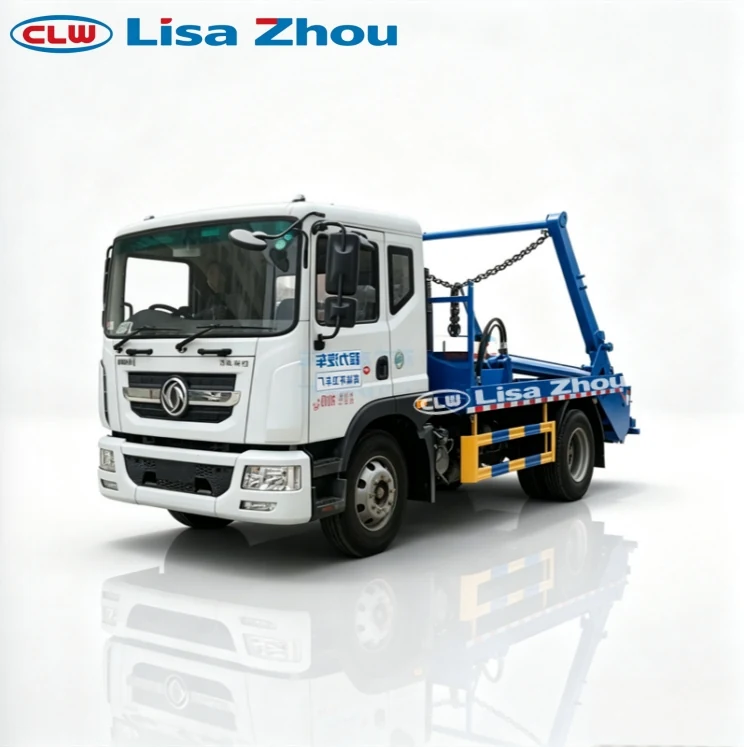
10 m³ Swing-Arm Skip Loader Truck
- Waste body volume
- 10 m³
- Wheelbase
- 3950 mm
Price per vehicle
View modelUSD 23,000–29,000

CLW / VEHICLE COLLECTION
Explore skip loader trucks and specify the container, lifting arrangement and working space together.
Get a fleet quotationUSD 23,000–29,000
1–1 / 1
Tiered pricing: order more for a lower unit price. Large orders can be delivered in phases.
BUYER QUESTIONS
Compare the lifting interface, loaded skip mass and site clearance before choosing a carrier. Container volume alone does not define the job.
A skip loader commonly uses lifting arms and chains attached to defined lifting points on the skip. A hook lift engages a container pickup bar and moves the container over its rails and rollers. Their container interfaces and operating movements differ. Choose according to the skips already on site, loading arrangements and available working space, then confirm the exact arm, chain or hook configuration in the proposed equipment.
Check the total mass of the skip and its contents against the equipment rating for the specified lifting position. Then check transport gross weight, axle loads and remaining payload on the complete truck. A lifting rating is not a promise that the same mass of waste can be carried on the road. Send skip tare, the heaviest intended load and its distribution so both the lift and transport configuration can be assessed.
Specify the skip’s length, width, height, empty mass and lifting-point positions, together with its intended loaded mass. Match these to the arm geometry, chain arrangement, support positions and transport restraints of the selected vehicle. Two skips with the same cubic-metre capacity can have different pickup geometry or centre of gravity. Provide drawings or measured photographs instead of choosing compatibility from nominal volume alone.
Allow for vehicle access, turning and the separate lifting movement. Arms, chains, supports and the moving skip need a defined operating area with adequate overhead and side clearance. Ground conditions and slope also belong in the site brief. Send a measured layout and photographs of the pickup and unloading locations. Request the selected equipment’s working-envelope drawing; the parked vehicle dimensions do not describe its full operating space.
It can be considered for suitable material and a specified skip, but mass usually becomes the key check. Rubble or other dense loads may reach the permitted weight well before filling the skip. Define the material, loading method, skip mass and expected load distribution. Compare both the lifting equipment and complete vehicle limits, and confirm the skip construction for the intended duty. Do not treat container volume as an allowed lifting load.
Compare the chassis, arm arrangement, lifting specification, driving position and the number and construction of skips. Confirm whether containers, restraints, requested options and delivery services are included. A bare carrier and a complete truck-and-skip package are different supply scopes. Send the destination, quantities, skip drawings and working loads to receive an offer that can be compared with the product specification and your existing equipment.
LET’S SPECIFY YOUR FLEET
Send your waste type, bin dimensions, destination and vehicle quantity. We’ll discuss the chassis and collection equipment together.