
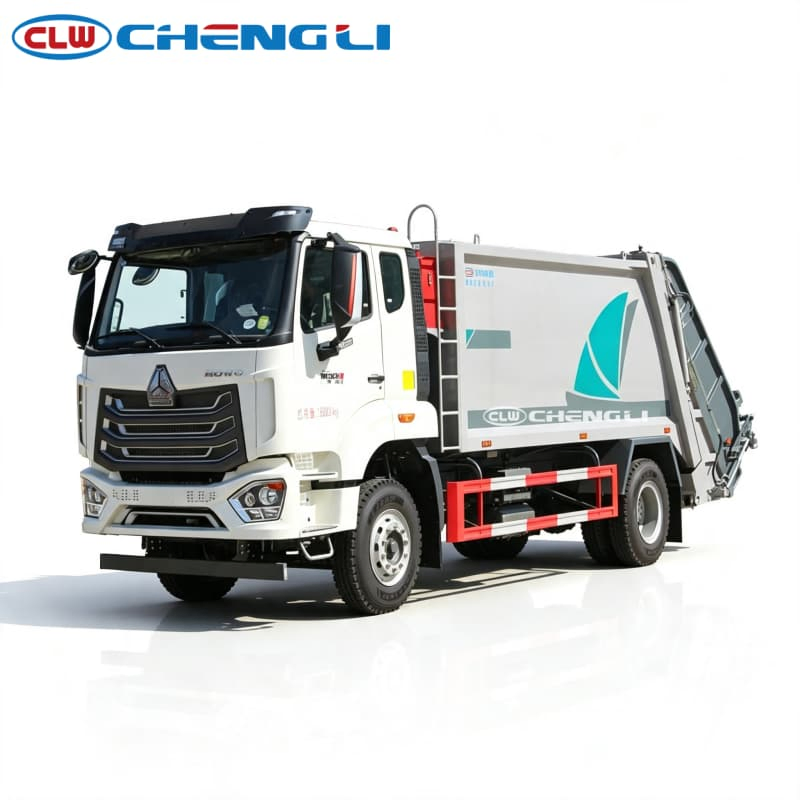
Start a HOWO garbage-truck comparison with the collection route, then compare the body, complete vehicle dimensions and permitted load. The products below cover a 5.5 m³ mini rear loader, 8 m³ and 12 m³ compactors, a 9.1 t GVW configuration, two separate 18 m³ configurations and a 13 m³ electric compactor. They offer different starting points for bin collection, rather than one interchangeable specification with different badges.
Compare seven HOWO compactor configurations, from the mini rear loader to 18 m³ and electric models. Follow each product link for its specifications and photographs. Match the chassis, bin lifter, axle limits and body equipment to the intended collection task.
Prices are in USD per vehicle. Compare quotations for the same chassis and body specification, options, quantity, destination, trade term, freight and inspection scope. On a small screen, swipe the tables horizontally.
1. HOWO garbage trucks: published models and reference prices
| Linked product | Listed body volume | GVW | Power source | Reference price per vehicle |
|---|---|---|---|---|
| HOWO 5.5 m³ Mini Rear Loader Compactor | 5.5 m³ | 4,495 kg | Diesel | USD 17,000–28,000 |
| HOWO 8 m³ Rear-Loader Compactor Truck | 8 m³ | Diesel | USD 27,000–29,000 | |
| HOWO 12 m³ Rear-Loader Compactor Truck | 12 m³ | Diesel | USD 30,000–34,000 | |
| HOWO 9.1 t GVW Rear-Loader Compactor Truck — CL 90 ZY | 9,100 kg | Diesel | USD 30,000–42,000 | |
| HOWO 18 m³ Rear-Loader Compactor Truck | 18 m³ | 18,000 kg | Diesel | USD 32,000–40,000 |
| HOWO NX 18 m³ Rear-Loader Compactor Truck | 18 m³ | 18,000 kg | Diesel | USD 42,000–48,000 |
| HOWO 13 m³ Electric Garbage Compactor | 13 m³ | Electric | USD 17,000–26,000 |
Compare the mini, mid-size, 18 m³ and electric configurations by operating task as well as price. Keep body volume separate from GVW and waste payload. For electric vehicles, include the battery, charging equipment and full operating duty in the budget.
2. Dimensions, wheelbases and interfaces side by side
| Configuration | Length × width × height | Wheelbase / key published detail |
|---|---|---|
| 5.5 m³ mini rear loader | 5,730 / 5,780 / 5,995 × 2,090 × 2,400–2,500 mm | 2,800 mm; listed payload 505 kg |
| 8 m³ rear loader | 6,890 × 2,300 × 2,750 mm | 3,280 mm; listed power 118 kW |
| 12 m³ rear loader | 7,630 × 2,360 × 3,000 mm | 4,000 mm; listed power 140 kW |
| CL 90 ZY, 9.1 t GVW | 6,770 / 6,790 / 6,960 / 6,980 × 2,100 / 2,150 × 2,580 / 2,650 mm | Dimensions vary by configuration |
| 18 m³ rear loader | 9,800 × 2,550 × 3,250 mm | 18,000 kg GVW; listed curb mass 11,500 kg |
| NX 18 m³ rear loader | 9,600 × 2,550 × 3,400 mm | 5,100 mm; listed 120 / 240 / 660 L bin interfaces |
| 13 m³ electric compactor | 8,820 × 2,550 × 3,400 mm | 4,500 mm; 194.44 kWh battery |
All seven configurations use a 4×2 drive layout. Do not infer 6×4 merely because a body is large. Treat alternative lengths or wheelbases as complete build options, and confirm which figures apply together in the order drawing. Mirrors, lifters, moving tailgates, hopper access and working clearances also belong in the site assessment.
3. The 5.5 m³ mini rear loader: compact dimensions need a realistic mass plan
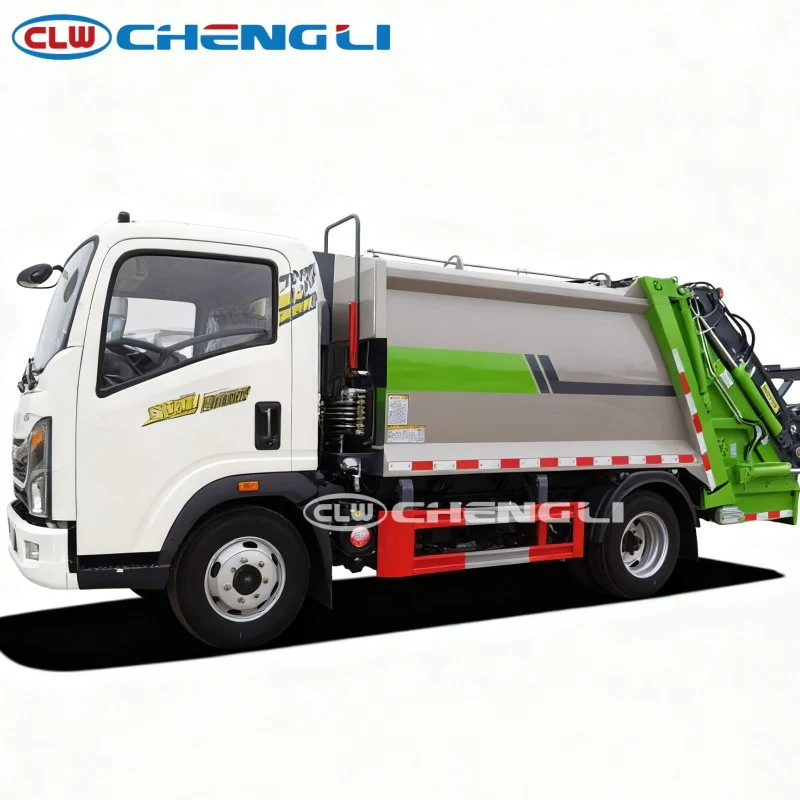
The HOWO 5.5 m³ mini compactor lists a 4,495 kg GVW, 3,860 kg curb mass and 505 kg payload. Its published width is 2,090 mm, with several length and height options. Those values make the mass question especially important: 5.5 m³ is not 5.5 tonnes of waste capacity, and the 4.495 t gross figure is not a waste-only load allowance.
The weight and axle-load guide explains how occupants, fitted equipment and axle distribution affect the usable load behind a published gross-mass figure.
Use the product's 505 kg published payload as a configuration figure to verify against the completed vehicle and its operating-mass basis. Do not replace it with a larger assumed load because the box appears spacious. Waste density, crew, equipment, fluids and axle distribution affect what can be carried legally and practically. Establish how frequently a small truck must unload before treating compact access as the only selection criterion.
The reference interval is USD 17,000–28,000. This can be a starting configuration for collection points with measured access constraints, but “mini” does not guarantee access. Check the whole turning and loading movement, the hopper position, overhead restrictions and the route to the receiving facility. A compact vehicle that spends too much of its shift travelling to unload can require a different collection or transfer arrangement.
4. HOWO 8 m³ versus 12 m³: compare volume and the larger footprint together
The HOWO 8 m³ rear loader lists dimensions of 6,890 × 2,300 × 2,750 mm, a 3,280 mm wheelbase and 118 kW power. The 12 m³ rear loader lists 7,630 × 2,360 × 3,000 mm, a 4,000 mm wheelbase and 140 kW. Both are diesel 4×2 configurations in this comparison.
The 12 m³ body has 50% more nominal volume than the 8 m³ body. The vehicle is also 740 mm longer, 60 mm wider and 250 mm higher, with a 720 mm longer wheelbase. Check these dimensions against the site and assess permitted payload, axle loads and collection time separately.
Compare the 8 m³ vehicle when its body and route envelope are sufficient for the measured workload. Investigate the 12 m³ vehicle where repeated trips are caused by the smaller body filling by volume and the larger build can use the same roads and discharge point. If the limiting factor is waste mass, stop time, a bin interface or a queue at the disposal site, additional cubic metres alone may not solve it.
The published ranges are USD 27,000–29,000 and USD 30,000–34,000. Ask for the same required lifter, controls, destination specification, driving position and quantity in the two quotations. Then compare the change in capital cost with a route-based estimate of trips and working hours, rather than assuming a percentage improvement equal to the volume difference.
5. Where the 9.1 t GVW CL 90 ZY fits
The HOWO CL 90 ZY rear-loader configuration has a 9,100 kg GVW and several dimensional options. GVW is the maximum gross vehicle mass; it should not be used as a waste-payload figure. Select the complete body and chassis specification for the intended load.
Its published widths of 2,100 or 2,150 mm and listed lengths from 6,770 to 6,980 mm can help begin a measured access comparison. The order must identify which length, width, height, body and chassis combination is supplied. Ask for a complete specification including curb mass, permitted waste load, axle distribution and lifter arrangement before including this model in a tender alongside an 8 m³ or 12 m³ model.
The reference interval of USD 30,000–42,000 overlaps other HOWO configurations. That is a reason to reconcile the proposed build and equipment scope. It does not show that every truck in the same gross-mass class costs the same or performs the same collection duty.
6. HOWO 18 m³: standard and NX configurations
| Vehicle specification | 18 m³ rear loader | NX 18 m³ rear loader |
|---|---|---|
| Product | HOWO 18 m³ rear loader | HOWO NX 18 m³ rear loader |
| Reference price | USD 32,000–40,000 | USD 42,000–48,000 |
| GVW | 18,000 kg | 18,000 kg |
| Drive and fuel | 4×2 diesel | 4×2 diesel |
| Dimensions | 9,800 × 2,550 × 3,250 mm | 9,600 × 2,550 × 3,400 mm |
| Curb mass | 11,500 kg | |
| Wheelbase | 5,100 mm | |
| Bin interface | Confirm the required configuration | 120 / 240 / 660 L listed |
| Controls | Confirm the required configuration | Electric / manual / remote-control options listed |
Both configurations have an 18 m³ body and an 18,000 kg GVW, yet the listed dimensions and price intervals differ. The NX vehicle is 200 mm shorter and 150 mm taller in the stated configurations, with the same 2,550 mm width. Do not interpret those measurements as an automatic advantage: the usable route, overhead envelope, body arrangement and discharge facility determine which build fits.
For either 18 m³ model, calculate usable waste payload from the configured vehicle mass, occupants, equipment and axle distribution. Keep each vehicle’s mass schedule with its own quotation; nominal body volume alone cannot establish the permitted load.
The NX offers 120, 240 and 660 L bin interfaces and electric, manual and remote-control options. Its loading cycle is 15–30 seconds and its discharge cycle is less than 25 seconds. These equipment-cycle figures do not include the complete stop, travel, queueing and unloading sequence of a collection route.
7. HOWO 13 m³ electric compactor: assess the whole duty and charging plan
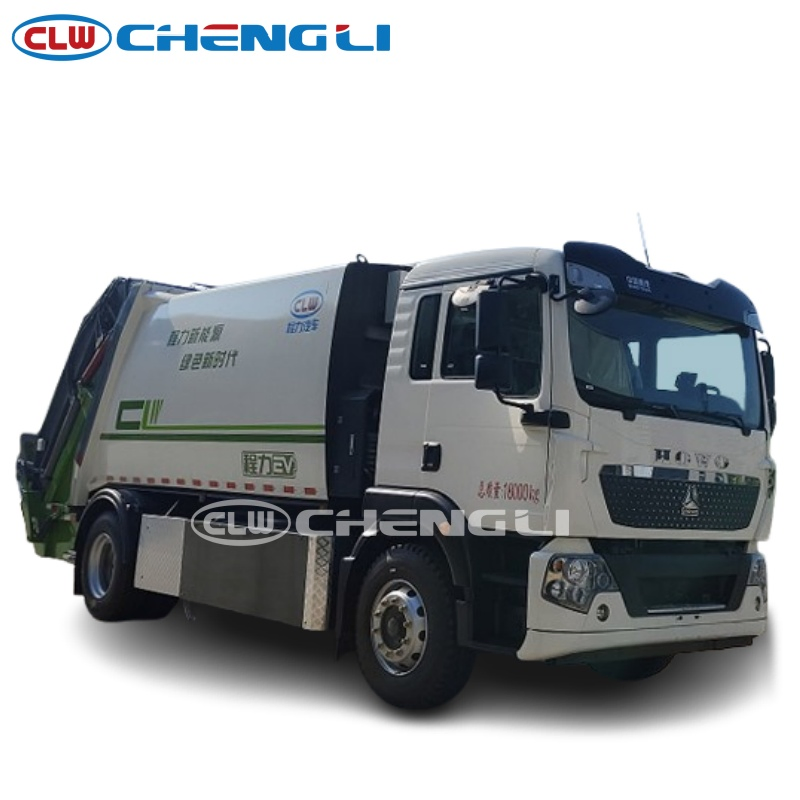
The 13 m³ electric compactor has a 194.44 kWh battery, a 4,500 mm wheelbase and dimensions of 8,820 × 2,550 × 3,400 mm. Specify the motor rating and duty basis in the technical proposal, together with loaded travel, compaction work and charging windows. For the 250 kW power specification, identify the rating and duty basis in the selected configuration.
The 13 m³ electric compactor has a price range of USD 17,000–26,000 per vehicle. Compare the complete battery, chassis, body, charging equipment, destination requirements and commercial terms with each diesel alternative. Evaluate energy and operating costs over the same route and workload.
Build an electric duty brief from loaded and empty distance, collection stops, hydraulic compaction, gradients, temperature, available hours and a reserve policy. Then describe the depot supply and charging windows. Battery energy alone cannot establish a guaranteed range, a number of loads per shift or a fixed energy-saving percentage. Charger power, installation and any additional infrastructure should be identified separately where they are outside the vehicle offer.
8. Turn the shortlist into a route comparison
| Operating condition | Configurations to compare | Evidence needed before deciding |
|---|---|---|
| Restricted access and smaller rounds | 5.5 m³ mini and CL 90 ZY | Measured vehicle movement, actual load per trip and unload travel |
| Established rear-bin rounds | 8 m³ and 12 m³ | Bin pickup, usable payload, stop time and disposal access |
| High-volume collection with suitable roads | 18 m³ and NX 18 m³ | Mass distribution, road/height limits, body equipment and facility capacity |
| Planned routes with depot charging | 13 m³ electric | Loaded duty, hydraulic work, charging windows and agreed battery/charger scope |
Record why the current fleet returns to unload: a full body by volume, a mass limit, end of shift or a site restriction. A larger body primarily addresses the first condition. Calculate the collection cycle using the same stop and travel assumptions for each candidate, then add breaks, queueing, discharge and charging or refuelling. Do not confuse a seconds-long compaction cycle with the time required to service a complete bin location.
For the volume-to-mass calculation used in route planning, see the capacity and compaction guide and keep measured inputs separate from catalogue capacities.
Illustrative planning example: 12 m³ of usable space at an assumed measured density of 0.25 t/m³ corresponds to 3 t of material. If the configured waste payload were only 2 t, the mass allowance would govern before that whole volume could be used. These are example inputs, not certified ratings for a truck above. Use measured route data and the chosen vehicle's approved load basis for the purchase decision.
9. Compare quotations with the same equipment and delivery scope
| Item | What the written offer should identify |
|---|---|
| Complete vehicle | Exact chassis identity, wheelbase, driving position, GVW and axle limits |
| Collection body | Nominal/usable volume, body material, hopper, bin lifter and discharge arrangement |
| Controls | The actual manual, electric, remote-control and safety equipment included |
| Permitted waste load | Configured operating mass, occupants/options and axle distribution |
| Energy system | Diesel engine and destination fuel requirements, or battery and charging scope |
| Commercial basis | Quantity, currency, trade term, freight, taxes, inspection and offer validity |
| Delivery and support | Delivery batches, documentation, training scope and initial spare parts |
CLW offers quantity-based pricing and phased delivery for larger orders. Request the unit price for your fleet quantity and agree the equipment, destination and batch schedule in the quotation.
The truck price and quotation guide provides a practical way to compare the chassis, body, lifting equipment and delivery boundary in competing offers.
Use the product links in the comparison tables to identify the proposed builds, then request a configuration quotation. The chassis comparison library brings the brand comparisons together.
Questions buyers ask
Which HOWO garbage trucks are compared in this guide?
Seven HOWO configurations: a 5.5 m³ mini rear loader, 8 m³ and 12 m³ rear loaders, the 9.1 t GVW CL 90 ZY, two 18 m³ models and a 13 m³ electric compactor. Product links provide each model’s specifications and price range.
Does the 5.5 m³ HOWO mini carry 5.5 tonnes of waste?
No. The 5.5 m³ mini has a 4,495 kg GVW and a 505 kg rated payload. Body volume, gross vehicle mass and waste load are different figures. Check the complete operating mass and axle limits for the selected equipment.
How do the 8 m³ and 12 m³ HOWO compactors differ?
The listed 12 m³ body has 50% more nominal volume. Its listed vehicle is 740 mm longer, 60 mm wider and 250 mm higher, with a 720 mm longer wheelbase. These changes do not establish the same percentage increase in payload or daily output.
Are the two HOWO 18 m³ products identical?
Their dimensions and price ranges differ. Compare the exact chassis, complete mass schedule, body, controls and bin lifter in each quotation rather than assuming the two 18 m³ configurations have identical equipment.
What battery does the HOWO electric compactor use?
The 13 m³ electric compactor has a 194.44 kWh battery. Assess loaded travel, compaction work, gradients, ambient conditions and charging windows to plan the route; battery energy alone is not a range or shift-output guarantee.
Do the HOWO reference prices include freight and every option?
The USD ranges are prices per vehicle. Define the exact configuration, quantity, destination, trade term, freight, inspection and included options in the written quotation.