
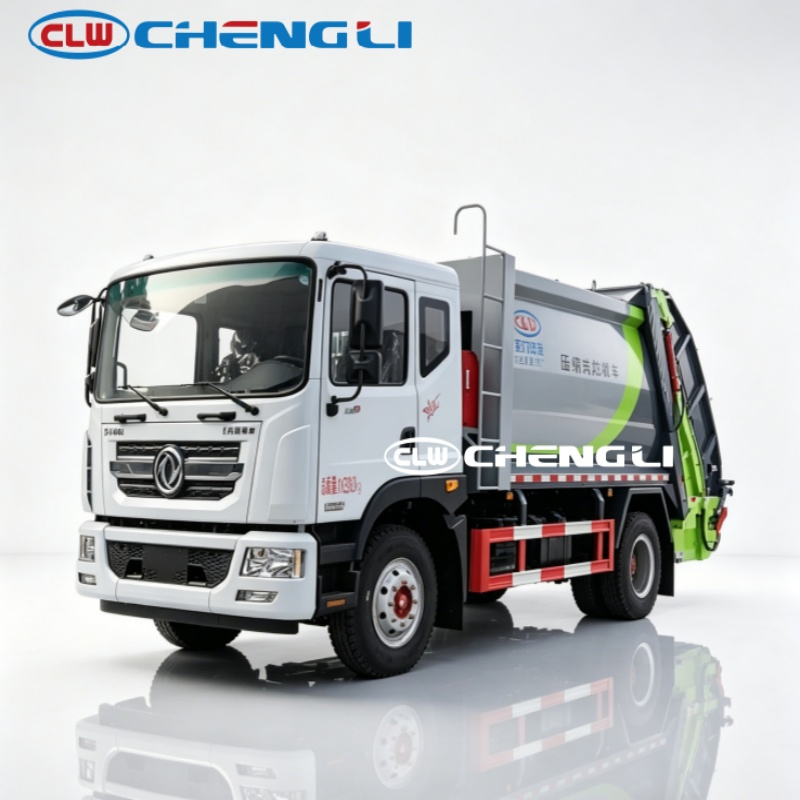
Which garbage truck prices can you compare here?
The table gives prices for specific CLW configurations, rather than a universal market price for every garbage truck. Body volume, collection mechanism, chassis and powertrain differ across the examples. Read each vehicle description with its own range. The lowest figure in one row is not a quotation for every variant in that family.
The HOWO model comparison and Shacman heavy-truck comparison provide published examples of separate configurations with different price ranges. Use those tables to shortlist, then compare exact chassis, body equipment and commercial scope in the written offers.
All amounts are in US dollars per vehicle. Keep that currency when comparing these examples; a conversion into another currency needs the applicable exchange rate and date. The 18 t description below is gross vehicle mass, not waste payload. Cubic metres describe volume, while tonnes describe mass; the two should not be substituted in a purchasing budget.
| Configuration | Price per vehicle |
|---|---|
| 9 m³ rear-loader compactor | USD 17,000–26,000 |
| 25 m³ rear-loader compactor | USD 28,000–34,000 |
| Dongfeng 9.5 m³ electric compactor | USD 21,000–27,000 |
| Dongfeng 13 m³ electric compactor | USD 25,000–33,000 |
| Dongfeng 3 m³ hook-lift configuration | USD 15,000–17,000 |
| Swing-arm skip loader | USD 30,000–35,000 |
| 18 t GVW electric refuse truck | USD 100,000–130,000 |
Tiered pricing applies: larger order quantities can reduce the unit price, and large orders can be delivered in phases. Request the quantity-based quotation and proposed delivery programme together. Do not infer a discount percentage, a delivery date or an identical price for every driving-position and equipment variant from the ranges above.
Why does vehicle type change the comparison?
A compactor collects suitable waste into its body and uses packing equipment. A hook lift carries a compatible detachable container. A skip loader handles a suitable skip through its specified lifting arrangement. These vehicles perform different collection tasks, so equal purchase prices would not make them interchangeable.
Describe whether the operation empties existing bins, removes a loaded container or transfers waste through a station interface. Include the equipment already owned. A container carrier quotation should identify the container scope, while a compactor quotation should identify the loading and bin-lifting equipment. Comparing only the cab appearance can leave an essential part of the collection system outside the budget.
Does a larger body always mean a higher or better price?
Body volume is only one input. Chassis specification, available waste payload, equipment and destination requirements also influence the proposal. The 9 and 25 m³ rear-loader rows are different configurations, not a fixed price-per-cubic-metre formula. Their ranges cannot be interpolated into an exact price for an intermediate size.
Check whether more volume solves the operating constraint. A larger box does not remove axle limits, restricted access or a long unloading cycle. Use the compactor size guide to compare volume and usable daily capacity. Buying unused nominal space can be less useful than selecting a complete vehicle that can finish the route.
Why are electric examples priced differently?
Electric configurations are not one uniform product. Compare the specific chassis, battery and body-working arrangement, along with the collection equipment and destination specification. The electric rows above belong to different configurations; their differences should not be read as the isolated cost of changing a diesel engine to an electric drive.
For an electric proposal, provide daily travel and body-work demands, charging facilities and the available charging window. Purchase price alone does not establish route range, energy cost or battery replacement cost. Those ownership calculations need the proposed vehicle's technical information and the operator's actual conditions. Do not assume an electric model and a diesel model have identical usable payload.
Which equipment choices need to appear in the quotation?
Identify the bin lifter or container interface, packing or lifting mechanism, controls, body finish and any specified environmental equipment. Ask for the offered components and options to be described clearly. A generic customisable label does not identify what is included in a particular price.
Separate the base configuration from requested additions and alternatives. Include manuals, training, initial spare parts and inspection scope where required. This helps compare two offers without assuming that a lower total contains the same equipment. It also gives the operator a record of which components and support arrangements apply after delivery.
What belongs in a delivered-and-ready budget?
Begin with the vehicle price, then add the applicable delivery and entry-into-service costs. Avoid counting a cost twice if it is already included in a quoted package. A useful budget separates the vehicle, freight and insurance, destination charges, inland transport and the local steps required before operating the complete vehicle.
| Budget item | What to identify | Comparison risk |
|---|---|---|
| Vehicle and equipment | Configuration, quantity and included options | Different equipment hidden behind one total |
| Transport and insurance | Agreed handover point, route and insurance scope | Treating a vehicle-only price as delivered |
| Destination processing | Applicable duties, taxes, clearance and local charges | Applying another country's rates |
| Inland delivery and entry into service | Local transport, registration and required checks | Leaving operating-start costs outside the budget |
| Operating preparation | Training, initial spares, depot and charging needs | Assuming every supporting item is included |
No duty percentage or registration fee is assumed here. Determine those amounts for the destination and the actual vehicle classification with the appropriate local parties. The point of the budget is to identify who supplies each amount and what it covers, rather than add a convenient universal percentage to the truck price.
How should shipping and delivery be quoted?
State the destination and agreed delivery location, then request the transport scope in writing. Vehicle dimensions, route, shipping method and the required handover arrangement affect the transport proposal. Clarify responsibility for the vehicle at each stage and the documents that accompany it.
The shipping and delivery page helps organise the enquiry. An earlier shipment's freight figure or transit time is not automatically applicable to a new order. Obtain the programme for the actual quantity and build, especially where the order is delivered in phases or several vehicle types travel through different arrangements.
Can LHD and RHD be compared at the same price?
Ask for the specific proposed build rather than assuming that a steering-side change leaves the price and equipment unchanged. State LHD or RHD, the collection side, control positions and destination requirements. The full RHD build guide and LHD/RHD selection guide explain the related configuration questions.
Compare equivalent operating scope: cab layout, visibility, body controls and collection interface. A price for a different chassis or working-side arrangement may not answer the same requirement. Driving position alone also does not prove registration eligibility or emissions acceptance. The destination and complete vehicle must be identified in the offer.
How should quantity discounts and phased deliveries be evaluated?
Provide the total requirement and the quantities wanted in each delivery phase. Ask for the unit-price basis, the configuration to which it applies and the proposed release of vehicles into service. A large fleet order may involve several body types, so do not treat every vehicle as an identical unit for budgeting purposes.
Compare the commercial schedule with the operating plan. Phased handover can be planned around the fleet's needs, but its dates and conditions belong in the actual proposal. No deposit ratio, production lead time or discount percentage is implied by the general availability of tiered pricing. Define those terms for the order being discussed.
Is a used truck price a useful comparison?
It can be useful only when the condition and scope are made explicit. Age, operating history, body wear, component condition and the suitability of existing documents can change the work needed before service. A lower purchase price is not a complete calculation of the cost of acquiring usable collection capacity.
Compare a new and used proposal on the same collection requirement and destination basis. Include inspection, repairs, equipment changes and support where applicable. The CLW examples in this article are configuration price examples; they are not a used-vehicle valuation guide or a guarantee of resale value.
What should a total ownership comparison include?
After establishing acquisition cost, examine energy, maintenance, tyres, staff tasks, spare parts and planned downtime over the intended service period. Use the route's achievable daily output as the basis for a cost-per-tonne calculation. A fast isolated mechanism cycle does not determine the whole shift's productive work.
Keep assumptions visible and compare like with like. If energy tariffs, fuel prices, annual distance or maintenance arrangements are not yet defined, leave the corresponding estimate open until they are supplied. Do not turn a difference in purchase price into a precise lifetime saving without a complete and applicable calculation.
How can buyers obtain a comparable final quotation?
Prepare one configuration brief and have each proposal identify equipment, quantities, price basis, delivery scope and supporting documents against it. Ask for alternatives to be separated from the main offer. This prevents a cheaper chassis, missing lifter or different delivery location from being mistaken for a discount on an equivalent vehicle.
The manufacturer purchasing checklist covers related supplier and inspection questions. Retain the agreed configuration and revision for production and handover. The final price comparison should connect a clearly defined truck to a clearly defined commercial scope, rather than compare unrelated catalogue headlines.
What should you send CLW for a vehicle price?
Send the destination country, vehicle type, quantity, waste description, required body or container size, expected waste load and collection method. Add bin drawings or photographs, route restrictions, unloading arrangements, LHD or RHD, chassis preferences and specified emissions requirements. Describe desired options, delivery location and any phased-order needs.
Request your garbage truck quotation with this information so the vehicle, collection equipment and quantity pricing can be considered together. Use the example ranges to organise the discussion, then compare the order-specific proposal and its delivery scope before setting the final purchasing budget.
Questions buyers ask
Are the USD 15,000–130,000 examples a price range for every garbage truck?
No. They span the specific CLW configurations in the table. The relevant price depends on the named vehicle, quantity, equipment, driving arrangement and the actual quotation scope.
Is the lowest truck price the delivered cost?
Do not assume that. Read the quoted handover location and included scope, then identify applicable transport, insurance, destination processing, local delivery and entry-into-service costs without double counting.
Can I calculate another body size by multiplying a price per cubic metre?
No fixed price-per-m³ rule is established by these examples. Chassis, usable payload, body mechanism, options and destination specification may differ between sizes.
Do you offer quantity pricing and staged delivery?
Tiered pricing applies, with lower unit pricing available for larger quantities, and large orders can be delivered in phases. Request the quantity-based offer and delivery programme for the specific vehicle mix and order.