
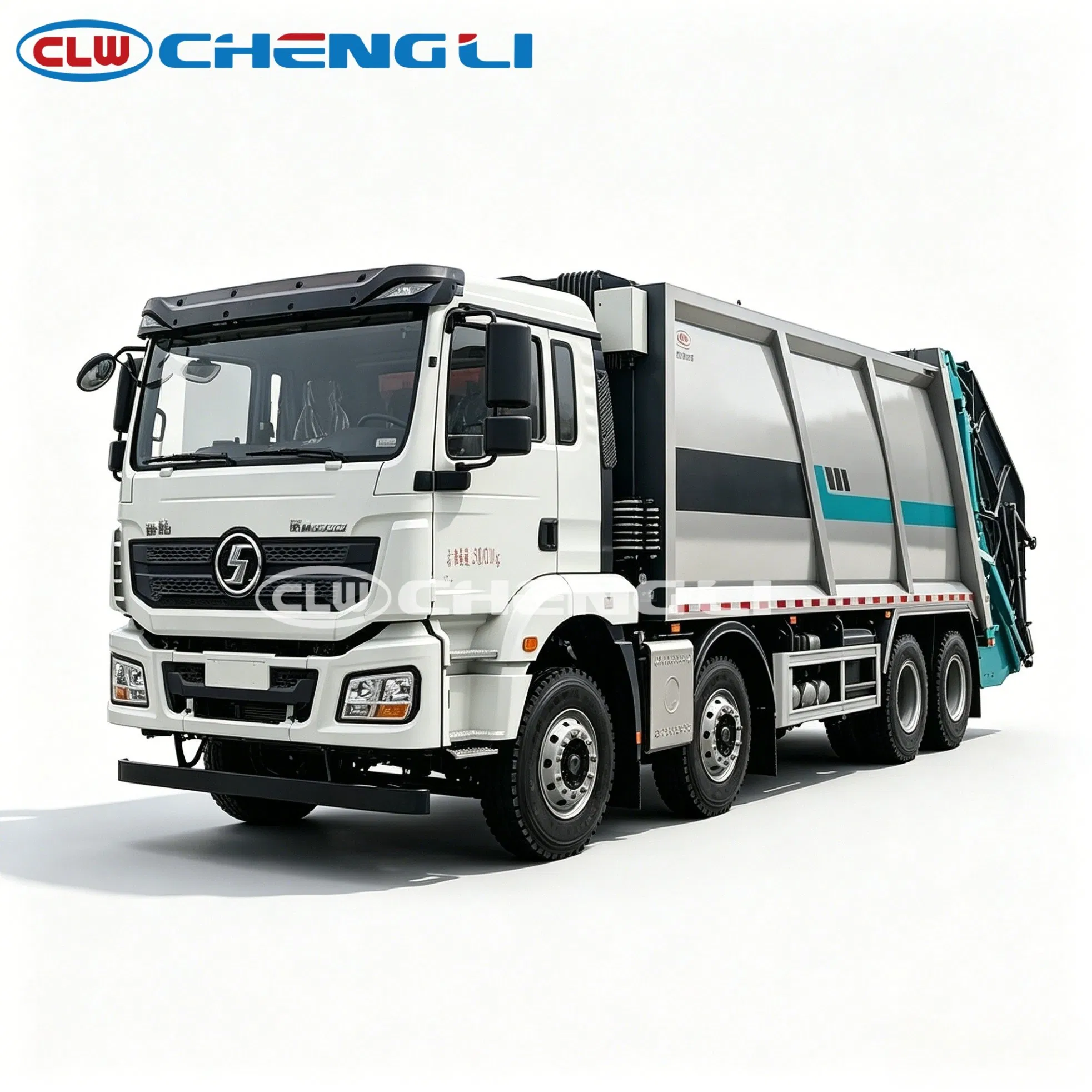
What should a compactor truck quotation actually describe?
Begin with the complete vehicle, not a price attached to a broad catalogue label. Specify the collection task, destination, quantity and required driving position, then ask for an itemised proposed configuration. A quotation for a chassis and body may differ from one that also includes a particular bin lifter, agreed accessories and delivery services. Keep the commercial scope beside the technical description when comparing totals.
CLW’s rear-loader compactor range is a starting point for selecting that vehicle family. For a broader view of vehicle types and budget examples, use the garbage truck price guide. This page concentrates on the seven choices that should be resolved before two compactor offers are treated as equivalent.
1. Chassis brand and exact specification
A chassis brand alone is not a purchasing specification. Record the model designation, cab, engine, transmission, wheelbase, axle arrangement and proposed complete-vehicle mass. A larger chassis or a different transmission changes the component package being purchased. Request a separate price for each acceptable alternative instead of assuming that one brand always costs more or that similarly named chassis have the same body allowance.
Choose between alternatives on the basis of the route and the complete body installation. Ask what changes in access dimensions, useful payload, service parts and the offered documentation. Compare a manual and another transmission option only when both are actually available for the selected model. Treat any price difference as an actual quoted difference, rather than applying a catalogue-wide percentage to an unspecified truck.
2. Body volume and useful waste payload
Increasing nominal body volume changes the proposed body and may require a different chassis. It does not automatically produce a proportional increase in useful waste load or daily output. Compare volume in cubic metres alongside complete vehicle mass, empty configured mass, permitted axle loading and useful payload. The body and lifting equipment themselves occupy part of the chassis carrying allowance.
Two configuration examples illustrate why size needs context: a 9 m³ rear compactor has a USD 17,000–26,000 price range, while a 25 m³ rear compactor has a USD 28,000–34,000 range. These are separate configuration examples, not a price per cubic metre or a range covering every CLW vehicle. The photo above does not identify either example. Ask for the exact model, included equipment and delivery scope behind your own quote.
3. Emission specification and destination documents
State the destination country and the actual documents required for the purchase and intended road use. An emission label is one part of a vehicle specification; it does not establish that every other import, registration or project requirement is satisfied. Ask for the offered engine specification and the documents tied to that exact chassis and complete vehicle. Keep destination acceptance separate from a general sales description.
If a different engine or after-treatment package is proposed, obtain its actual price and service requirements as an alternative. There is no reliable universal surcharge for moving between emission labels across unrelated chassis. Avoid paying for a badge without checking the exact engine and document scope, and avoid choosing a cheaper alternative that fails your stated requirements. Local acceptance should be resolved before the order specification is fixed.
4. LHD or RHD and the complete layout
Write left-hand drive or right-hand drive in full and identify the final destination. Availability depends on the selected chassis and model. Changing the required driving position can change the available chassis choices, so an RHD price should refer to a specific proposed vehicle. It should not be produced by adding an assumed percentage to an unrelated LHD offer.
Cab position also needs to be distinguished from the collection working side and body controls. Compare the proposed cab, external controls and collection layout as a complete arrangement. The RHD garbage truck buying guide helps organise those questions. A photograph of a similar truck does not replace a written configuration, and a normal traffic direction does not itself establish vehicle registration eligibility.
5. Bin lifter, pickup interface and controls
A basic description such as “with bin lifter” can leave substantial scope undefined. Provide the bin type, drawing, pickup profile, dimensions and maximum loaded mass. State whether the same vehicle must handle more than one interface. Ask the supplier to identify the proposed lifter, its working arrangement and the controls included in the quotation. Compare the complete offered interface with the bins you actually use.
Adding equipment adds items to the purchase scope, but the net vehicle price still needs a specific quotation. Request a base configuration and an itemised compatible alternative rather than treating an omitted lifter as a saving with no operational consequence. If a lifter or control option is not available on the selected body, choose a supported alternative; do not assume that every catalogue accessory can be fitted to every compactor.
6. Surface preparation and corrosion protection
Ask what the proposed protection consists of: the treated surfaces, preparation process, coating system and any agreed inspection or maintenance instructions. “Anti-corrosion” on its own does not define a comparable package. Describe the actual exposure, such as frequent washdown or a coastal operating environment, so that an alternative can address a real use condition rather than an undefined premium finish.
A more extensive preparation or coating scope may change the quoted work and materials, but its cost and expected suitability must be explained for that actual package. Do not convert a coating description into a promise of a particular service life. Compare the included process and written care requirements, and request a separately priced alternative where available. Keep cosmetic colour choices distinct from protection of relevant body surfaces.
7. Transport method and delivery boundary
A vehicle price and a delivered project total answer different questions. Identify the handover location, loading or port scope, freight arrangement and any other included services. Ask which charges remain outside the offer. If a trade term is used, include its named place or port and clarify the quoted services; a short abbreviation by itself is not enough to compare two complete delivery proposals.
Shipping method depends on the actual vehicle dimensions, route and available service. Obtain a current transport proposal rather than assuming that a compactor will fit a particular container or that a standard freight figure applies worldwide. Keep vehicle manufacture, transport services and destination charges distinguishable. Confirm the offer validity and delivery arrangements in the quotation; a catalogue price is not a guaranteed freight rate or departure date.
How can buyers compare the seven factors efficiently?
| Factor | Define the base offer | Request the alternative separately |
|---|---|---|
| Chassis | Exact model, cab, transmission and axle layout | Name each different chassis or transmission |
| Body size | Nominal volume and configured useful payload | Show the complete chassis/body combination |
| Emission specification | Engine designation and required documents | Identify the different engine and document scope |
| Driving position | LHD or RHD on the named chassis | Confirm exact availability and complete layout |
| Bin handling | Pickup interface, loaded bin mass and controls | Itemise a different compatible lifter |
| Protection | Preparation and coating scope | Define added surfaces, process and materials |
| Delivery | Named handover location and included services | Separate a different transport or delivery scope |
Ask for one base offer and a short, clearly identified set of alternatives. This is easier to assess than several totals with changing chassis, capacities and delivery boundaries. Mark which requirements are essential and which are preferences. A cheaper option may be useful when it still meets the task, but an option with a different interface or excluded service should be evaluated as a different scope.
How do order quantity and phased deliveries fit the price?
CLW uses tiered pricing: larger order quantities can receive lower unit prices. Large orders can be delivered in phases. State the total planned quantity, the proposed batch sizes and the destinations in the enquiry. Ask for the applicable unit price and delivery arrangement for that order, rather than inventing a discount rate or assuming that one unit’s quote scales unchanged to a fleet.
For phased deliveries, identify whether each batch has the same vehicle specification and handover location. Record any proposed configuration changes separately so that later batches are not compared against an outdated scope. Agree the commercial and delivery terms for the actual order; phased delivery does not imply an open-ended price guarantee or a particular credit arrangement.
What should you send CLW for a useful quote?
Send the destination, quantity, driving position, intended waste stream and collection method, followed by the bin interface and route constraints. Include your preferred chassis or the characteristics an alternative must meet. Add any existing drawings and the requested delivery boundary. The chassis options page helps frame the chassis discussion without replacing the complete vehicle specification.
Use the CLW quotation form to submit the brief and ask for a base configuration with itemised alternatives. Request clarification of missing scope before choosing between prices. The goal is a truck and collection system suited to the job, with a quotation that makes the equipment, quantity and delivery arrangement understandable.
Questions buyers ask
Can I compare compactor prices only by body volume?
No. Compare the exact chassis, configured useful payload, bin-handling equipment and delivery scope alongside nominal body volume. A cubic-metre figure alone does not describe the complete vehicle.
Does RHD always add a fixed percentage to the price?
No universal percentage applies. LHD or RHD availability depends on the selected chassis and model. Request a price for the exact offered RHD configuration and collection layout.
What should an anti-corrosion option specify?
Ask for the treated surfaces, preparation process, coating system and written care requirements. A broad label does not establish the included work or a guaranteed service life.
Can a fleet order have a lower unit price and several delivery batches?
CLW offers tiered pricing for larger quantities and phased delivery for large orders. Provide total quantity, batch sizes and destinations so the quotation can state the applicable unit prices and agreed delivery arrangement.