
What is the main difference between rear and side loading?
The first difference is where waste enters the vehicle. A rear loader receives it at the back, commonly through a hopper and the specified lifting or loading arrangement. A side loader receives material through equipment on a defined side. These terms identify collection position; they do not fully describe body construction, compaction, bin compatibility or automation.
Compare the actual rear-loader configurations and side-loading options against the same operating brief. A vehicle with a simple side-mounted bin lifter and a vehicle with an automated reach arm are different proposals. Avoid replacing one with the other in an enquiry simply because both are described as side loaders.
Does side loading always mean an automated arm?
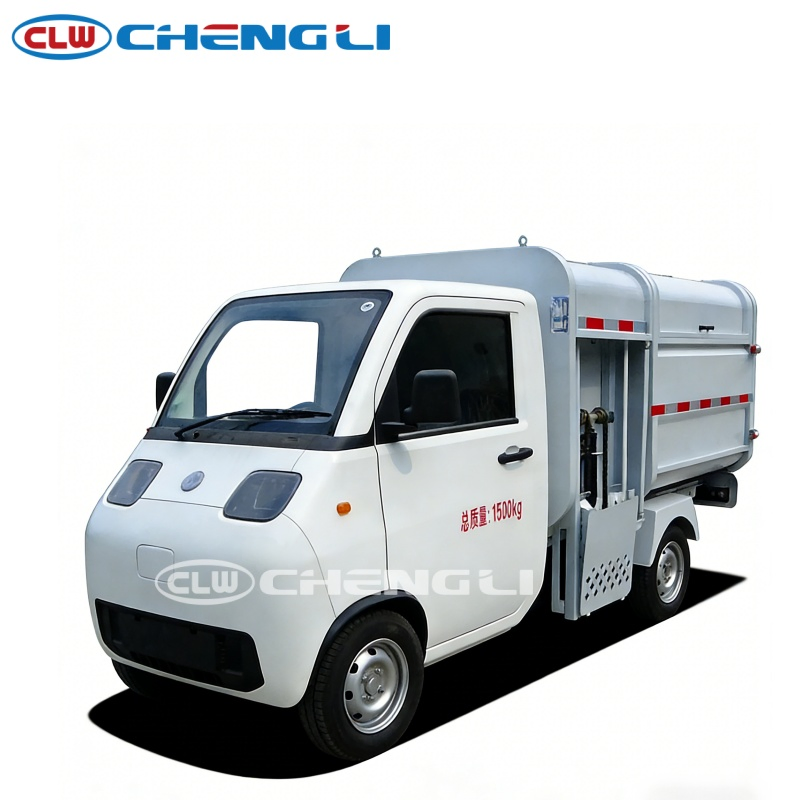
No. Side-loading arrangements can involve manual presentation of bins, assisted lifting or a specified automated pickup mechanism. The photograph shows a side-mounted lifting arrangement on a small collection vehicle. It illustrates loading position; it does not establish that every side-loading body uses an automated reach arm or the same compaction system.
Have the proposal identify the actual lifting sequence, the tasks that remain with the crew and the container interface. For an automated system, obtain the applicable pickup and operating envelope. For an assisted system, describe how bins are brought to and removed from the lifter. This distinction is more useful than an automation label without a defined working method.
Which differences should go into the comparison schedule?
| Decision | Rear-loading proposal | Side-loading proposal |
|---|---|---|
| Collection position | Waste enters through the rear loading arrangement. | Waste enters through equipment on a specified side. |
| Bin handling | Specify the rear lifter and the way bins reach it. | Distinguish assisted lifting from an automated pickup arm. |
| Working space | Check space behind the vehicle and crew movement. | Check the side movement, bin position and nearby obstacles. |
| Street access | Measure the complete vehicle, turning and rear work area. | Measure the complete vehicle, turning and side work area. |
| Crew tasks | Record bin movement, lifting, observations and other duties. | Record presentation, pickup, exceptions and assisted collections. |
| Daily output | Compare payload and the complete route-and-unloading cycle. | Use the same basis; an arm cycle is not a full collection cycle. |
| Purchase cost | Compare the exact chassis, body, lifter and support scope. | Include the specified mechanism and any changes to the bin system. |
| LHD/RHD | Coordinate driving position, controls and collection practice. | Also match the loading side to the intended route and collection edge. |
Which layout fits narrow streets and parked vehicles?
There is no reliable rule that one loading position always suits a narrower street. Measure the complete truck's width, height, turning space and relevant operating envelope. A side mechanism needs its defined movement and bin pickup area. A rear loader needs a workable rear collection area and a safe plan for the crew and other street users.
Parked vehicles, trees, poles, slopes and overhanging structures may constrain different parts of the task. Include the actual collection points rather than only a typical road width. The narrow-street collection page helps frame an access brief. Changing body position does not solve a route that the complete vehicle cannot enter, turn within or work along.
How do bin type and presentation affect the choice?
Inventory the existing bins before choosing a lifter. Record their dimensions, pickup profiles, loaded masses and condition. Containers with the same nominal capacity may have different lifting interfaces. A proposed grabber, comb, trunnion or other lifting arrangement must be assessed against the bins that will actually remain in service.
Next record where bins can be presented and whether users or staff must reposition them. A side pickup can depend on a specified position and clearance from obstacles; a rear system may require bins to be moved to a rear lifting point. Review the bin and lifter compatibility guide with photographs and drawings, not capacity labels alone.
How many people are needed on each truck?
There is no universal crew count for every rear or side loader. Identify the work: driving, moving bins, presenting them, operating equipment, observing the collection area and handling exceptions. Assisted collections, bulky material and inaccessible bin positions may change the tasks even when a pickup mechanism is automated.
Define staffing through the operator's route assessment and the applicable working arrangements. Automation can change a task without eliminating all other duties. Compare the proposed normal operation and the handling of missed or obstructed bins. A generic one-person versus three-person comparison can conceal differences in collection systems and create an unreliable operating-cost estimate.
Which layout moves more waste in a shift?
Compare useful waste mass and complete cycles rather than a single lifting movement. A full cycle includes collection stops, travel to the receiving facility, waiting, unloading and return to service. The loading mechanism is only one element. Also account for the time required to present bins and deal with the route's exceptions.
The example below uses two hypothetical proposals without assigning either to rear or side loading. It assumes 420 minutes available, complete cycles of 110 and 140 minutes, and three fully loaded trips in each case. These are selected calculation conditions, not CLW vehicle performance ratings. Actual routes and loading may produce a different result.
| Input or result | Proposal A | Proposal B |
|---|---|---|
| Available time | 420 min | 420 min |
| Complete cycle | 110 min | 140 min |
| Whole cycles possible | 3 | 3 |
| Assumed usable waste payload | 4 t/trip | 5 t/trip |
| Illustrative daily mass | 12 t | 15 t |
Although A has the shorter cycle, B moves more tonnes under these assumptions because its usable load is higher. If collection or queuing changes the achievable number of cycles, recalculate both proposals. The result shows why a faster arm, a larger body or a preferred loading position alone cannot determine whole-shift productivity.
Does a larger body make either option more productive?
Body volume in m³ and available waste payload in t are different limits. A larger box can help when space is the constraint, but cannot override gross-mass or axle limits. The chassis, body, lifter and other equipment influence the remaining usable payload. Compaction behaviour also depends on the actual material.
Use the compactor size comparison to examine volume, density and payload together. For mechanical background, the compactor working-principle article separates loading and packing functions. Do not assign a universal compaction ratio to a rear or side loader merely from its collection position.
How does LHD or RHD affect side-loading layout?
Specify both driving position and working side. The intended pickup should face the collection edge in the planned traffic and route arrangement. Changing the traffic side can change the appropriate working side; one-way streets and the actual collection pattern also matter. Steering position alone does not determine the correct arm or lifter installation.
Coordinate cab visibility, body controls, crew access and bin presentation in the complete layout. The full RHD build guide explains these related decisions, while the LHD/RHD selection guide supports the destination brief. A specification should identify the proposed build rather than assume a steering change produces an equivalent vehicle.
Is side loading always more expensive to buy or cheaper to run?
Neither claim is a sound rule for every configuration. Compare quotations for the actual chassis, body, bin equipment, control system, destination specification and support scope. If an option requires different bins or presentation points, include that transition in the purchase plan instead of comparing truck prices alone.
For operating cost, use the route's staffing plan, energy demand, maintenance requirements and usable daily output. Include unloading journeys and equipment downtime assumptions. Without those inputs, a precise saving per tonne would be speculative. Keep vehicle purchase price and the cost of changing the collection system visible as separate items.
What should a route trial or site review examine?
Select representative collection points, including difficult access and obstructed presentations, and agree what will be observed. Record completed collections, crew tasks, interruptions, available working space and the receiving-site cycle. Use the proposed bins and a representative waste brief. A demonstration at an empty depot does not show every constraint of a busy street route.
HSE's waste-transport guidance emphasises route assessment and reducing reversing risks. Apply an appropriate operating and safety assessment to either configuration; neither loading position removes the need to manage pedestrians and vehicle movements. Establish suitable controlled conditions and competent supervision for any demonstration.
When does a mixed rear-and-side-loading fleet make sense?
Different collection areas can justify different configurations. A route with consistent compatible bin presentation may have different needs from one with varied containers or frequent assisted tasks. Evaluate each route group instead of forcing one mechanism onto every area for visual or catalogue uniformity.
A mixed fleet also needs an explicit parts, training and maintenance plan. Compare the benefits of route fit against the additional equipment variations the operator will support. There is no need to make every truck identical, but each added variant should have a defined collection task and usable technical documentation.
What should you send CLW to compare rear and side loaders?
Send the destination, vehicle quantity, daily waste mass, route description, measured access and unloading arrangement. Include bin drawings or photographs, pickup profiles, loaded masses, presentation positions and the intended working side. State LHD or RHD, chassis preferences, specified emissions requirements and whether assisted or automated pickup is required.
Describe the crew's current tasks and any planned changes, along with charging arrangements for an electric proposal. Request a rear-versus-side-loader comparison against the same brief. The useful result is a complete vehicle and collection method suited to the route, supported by comparable equipment scope and operating assumptions.
Questions buyers ask
Is every side loader an automated garbage truck?
No. Side loading identifies the collection position. It can use assisted lifting or an automated pickup arrangement; the proposal should identify the actual mechanism and crew tasks.
Can a right-hand-drive truck use the same side-loading arrangement as a left-hand-drive truck?
Assess the specific layout. The intended route, collection edge, visibility, controls and bin presentation determine the working-side requirement; moving the steering wheel alone does not demonstrate an equivalent installation.
Does a quicker bin-lifting cycle guarantee more tonnes per shift?
No. Available waste payload and the complete collection, travel, queue and unloading cycle also determine output. Compare the whole shift with explicit route assumptions.
Should a municipality use only one loading type?
Not necessarily. Compare route groups and existing bin systems. Different configurations may fit different tasks, provided the operator plans the associated training, parts and maintenance support.