
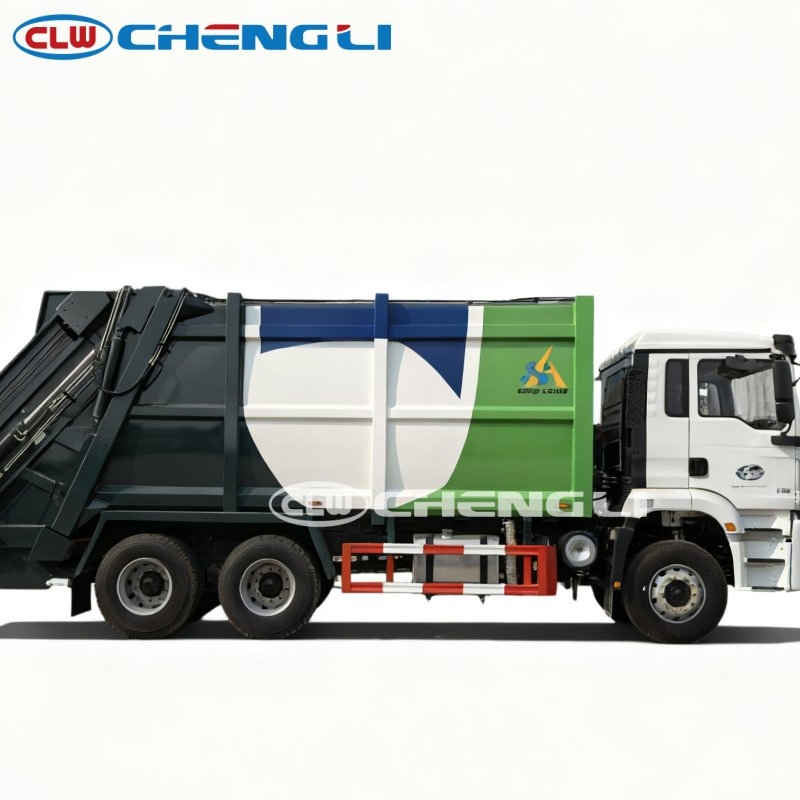
Compare two complete Shacman heavy rear-loader configurations: the 26 m³ 6×4 with a 25,000 kg GVW and the CL 11 ZY 8×4 with a 31,000 kg GVW. Size the vehicle around the waste stream, permitted load, route and unloading method, keeping body volume separate from gross vehicle mass.
Both Shacman configurations are diesel rear-loader compactors with manual transmission. Compare each complete chassis, body mounting, axle limits and bin-handling equipment for the intended route.
Prices are in USD per vehicle. The written quotation should identify the chassis, body, options, quantity, destination and trade term, with freight, inspection and applicable taxes defined separately. On a small screen, scroll each table horizontally.
1. Shacman models and reference prices
| Linked product | Drive layout | GVW | Listed body volume | Reference price per vehicle |
|---|---|---|---|---|
| Shacman 26 m³ 6×4 compactor | 6×4 | 25,000 kg | 26 m³ | USD 25,000–42,000 |
| Shacman CL 11 ZY, 31 t GVW 8×4 | 8×4 | 31,000 kg | USD 80,000–100,000 |
The 31 t configuration has the higher price range. Compare offers with the same destination requirements, body material, bin-handling equipment and inspection scope to assess the complete investment.
2. Published dimensions and equipment side by side
| Vehicle specification | Shacman 26 m³ 6×4 compactor | Shacman CL 11 ZY, 31 t GVW 8×4 |
|---|---|---|
| Dimensions: length × width × height | 10,310 / 10,130 / 10,150 / 10,030 × 2,550 × 3,500 mm | 11,995 × 2,550 × 3,990 mm |
| Wheelbase options | 4,350 + 1,350 / 4,500 + 1,350 mm | |
| Fuel / gearbox | Diesel / manual | Diesel / manual |
| Engine detail | Yuchai / Cummins engine options | Weichai; 349–459 HP listed range |
| Controls | Hydraulic + electric + remote control listed | |
| Exact bin pickup and loaded-bin rating | Confirm required equipment | Confirm required equipment |
Keep each length and wheelbase option together with its matching chassis and body on the order drawing. For both configurations, specify the chosen engine and power rating, wheelbase, body dimensions and loading interface.
3. The 26 m³ 6×4: begin with volume, then verify mass
The Shacman 26 m³ 6×4 compactor combines a 26 m³ body with a 25,000 kg GVW. Plan the waste load using the complete vehicle mass, occupants, equipment and axle distribution. Measure the waste stream by both volume and mass before estimating loads per trip.
Consider this configuration where bins can be presented at the rear and the receiving facility accepts the discharge method. Match the lifter to the actual bin dimensions, pickup geometry and loaded bin mass.
A large nominal body helps only when it can be used within the working shift. Record whether existing vehicles return because the body is full, the mass limit is reached, the shift ends or the receiving point closes. More volume addresses only some of those causes. Include compaction, stop time, travel and queueing before estimating fewer unloading trips.
4. The 31 t 8×4: assess the larger complete vehicle
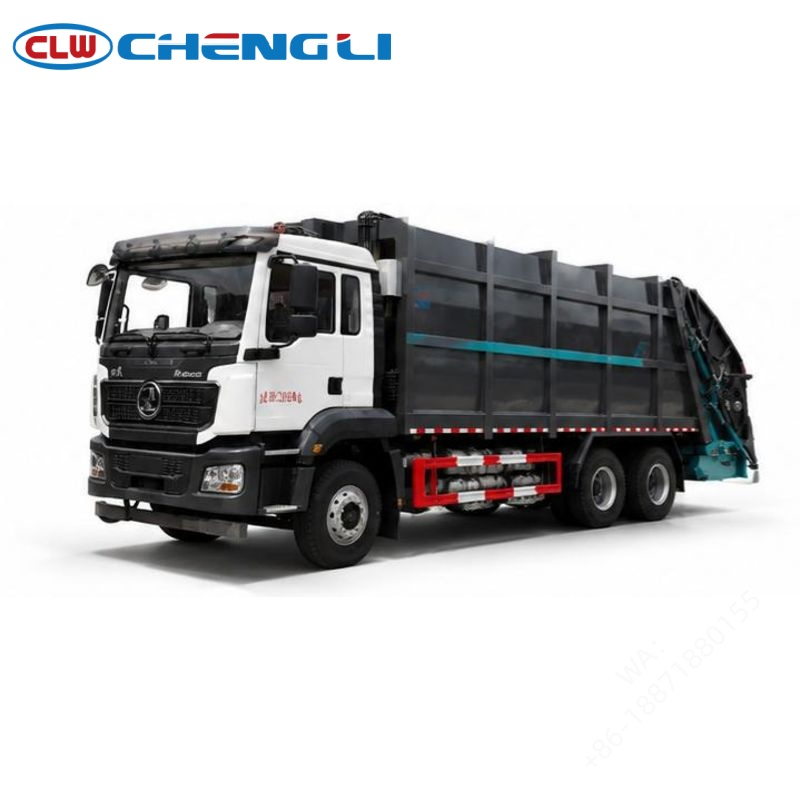
Shacman CL 11 ZY, 31 t GVW 8×4 lists dimensions of 11,995 × 2,550 × 3,990 mm. The 3,990 mm published height makes overhead access a specific planning item, including entrances, canopies, workshop doors and the disposal route. Verify the complete build and moving-equipment envelope rather than treating the static height as every clearance needed during work.
The weight and axle-load guide explains how to assess the completed vehicle and individual axles when comparing these gross-mass classes.
Its 31,000 kg GVW is 6,000 kg above the 25,000 kg GVW of the other configuration. This difference is not an additional 6,000 kg of waste payload. Compare the complete vehicle’s operating mass, body volume and axle distribution when planning each load.
5. What the 6×4 and 8×4 layouts mean for route assessment
In conventional truck notation these represent three-axle and four-axle arrangements with two driven axles; the designation counts wheel positions rather than every individual tyre. It does not establish an exact steering arrangement, turning circle, traction performance or permitted axle load for the supplied vehicle. Ask for the selected chassis specification and a swept-path assessment where access is tight.
For a structured access survey, use the vehicle dimensions guide to separate static dimensions from turning and working clearances.
Both configurations have a 2,550 mm width. Across the 26 m³ configuration’s length options, the 31 t vehicle is 1,685–1,965 mm longer and 490 mm taller. Check those measurements against real turns, kerbs, parking, collection stops and the receiving site. The added length cannot be translated directly into a turning-radius value, and the same width does not mean the two trucks need identical working space.
6. Compare the configurations against the operating constraint
| Operating question | 26 m³ 6×4 starting point | 31 t GVW 8×4 starting point |
|---|---|---|
| Body fills by volume | 26 m³ published; verify usable volume and payload | Compare usable body volume and permitted waste payload for the chosen build |
| Mass or axle limit governs | Request configured mass and axle distribution | Higher GVW alone is insufficient |
| Height or manoeuvring is restricted | Check selected length and 3,500 mm static height | Check 11,995 mm length and 3,990 mm static height |
| Stops or disposal queues consume the shift | Model the complete route cycle | Extra gross mass does not remove time constraints |
For a tender, use the same collection quantity, bin presentation, crew method, daily kilometres and receiving conditions for both candidates. Estimate loading, travel, unloading and return time, then identify whether the planned task is volume-, mass- or time-limited. A vehicle with spare body volume may still be fully utilised by time; a larger gross-mass class may be unnecessary if access already excludes it.
7. Compare prices with a complete equipment scope
| Item | Written confirmation to request |
|---|---|
| Vehicle identity and mass | Exact chassis, axle limits, completed mass, payload and driving position |
| Body and bin equipment | Usable volume, material, lifter geometry, hopper, controls and discharge system |
| Engine and support | Selected engine/rating, destination requirements, maintenance and agreed spare parts |
| Commercial basis | Quantity, currency, trade term, freight, taxes, inspection and offer validity |
| Delivery and acceptance | Batch schedule, documents, inspection criteria, training and included equipment |
CLW offers quantity-based pricing and phased delivery for larger orders. Request prices for the actual fleet quantity and required batches. Compare operating costs over the same collection task and period, including energy, staffing, maintenance and unloading travel.
The truck price and quotation guide helps turn the headline price difference into a comparison of named equipment and delivery scope.
8. Prepare a route-specific Shacman enquiry
Start with request a configuration quotation and describe daily waste mass and volume, composition, bins and pickup drawings, route restrictions, loading positions, receiving facility, shift length, destination and vehicle quantity. Include photographs of difficult access points and specify the complete vehicle and equipment on the order drawing.
Explore other garbage-truck and chassis configurations in the chassis comparison library.
Questions buyers ask
Which Shacman trucks are compared?
The CLW5256ZYS6WL 26 m³ 6×4 rear loader and the CL 11 ZY 31 t GVW 8×4 rear loader. Product links provide each configuration’s specifications and photographs.
Is the CL 11 ZY a 31 m³ truck?
No. The 31 t figure is GVW, the maximum mass of the complete loaded vehicle. Determine waste payload from the chosen body, operating equipment, complete vehicle mass and axle limits; tonnes of GVW are not cubic metres of body volume.
What are the reference prices?
Per vehicle: USD 25,000–42,000 for the 26 m³ 6×4 and USD 80,000–100,000 for the 31 t GVW 8×4. Exact configuration and commercial scope determine the quotation.
Does the higher GVW guarantee more waste per trip?
No. Completed vehicle mass, operating equipment, usable body volume and axle distribution are also needed. The gross-mass difference is not an additional waste-payload rating.
Do both trucks need the same access space?
Both list 2,550 mm width, but lengths and heights differ. Confirm the selected configuration, turning movements, loading clearances and receiving-site access.
Are bin lifters and remote controls identical?
The 26 m³ configuration offers hydraulic, electric and remote controls. Specify the selected lifter, bin interface and control equipment for each vehicle in the quotation.