
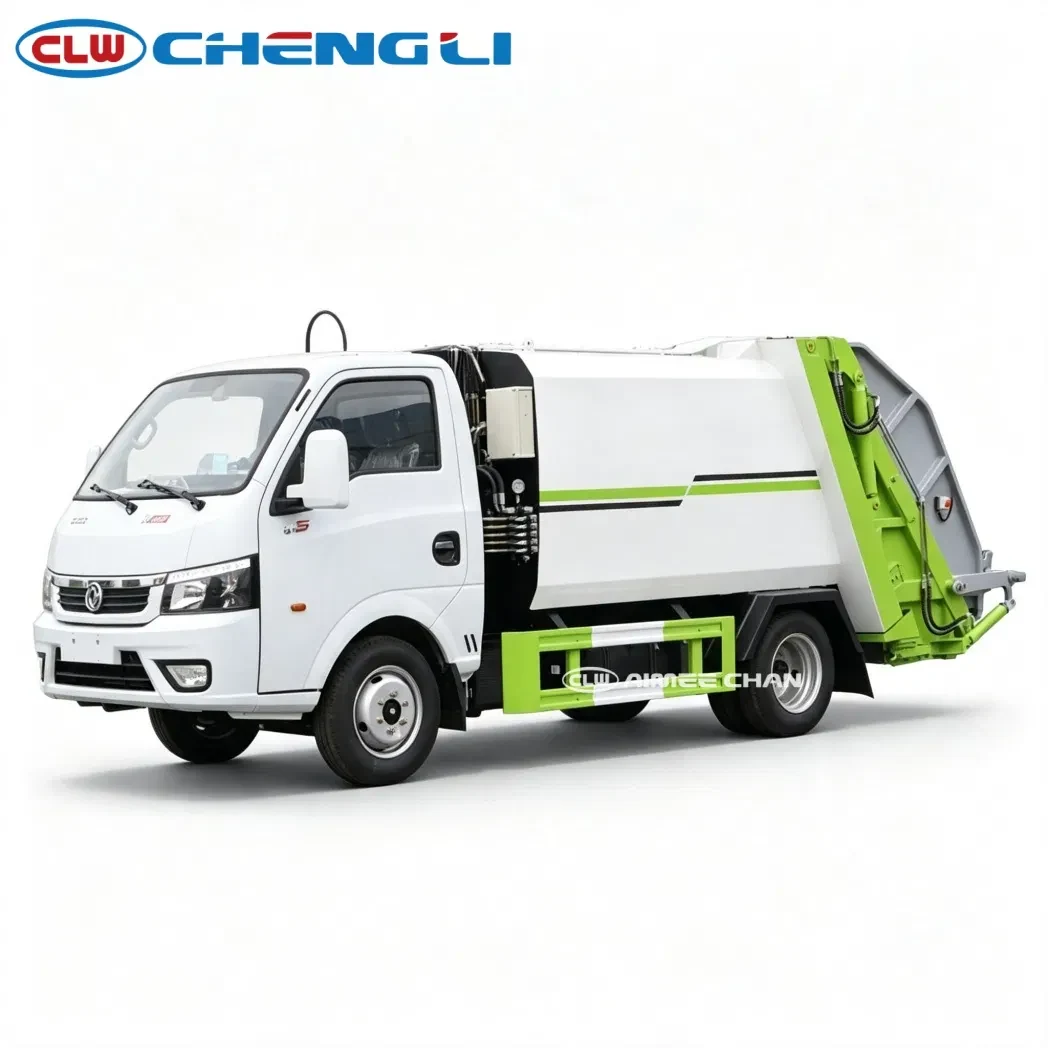
Start with the rear-loading job
A mini rear loader collects suitable refuse through a hopper at the back of the vehicle and packs it into an enclosed body. Its attraction is access: a smaller complete vehicle can suit collection points that are difficult for a larger truck. However, “mini” is a description, not a standardized payload, turning circle or road classification. Compare the actual dimensions, loading interface and permitted masses of each configuration.
Keep three measurements separate in the enquiry. Body volume describes storage space in cubic metres. Rated payload describes a permitted carried mass. Gross vehicle mass includes the complete vehicle and its load. A truck described as 4.5 tonnes gross is not thereby a truck with 4.5 tonnes of waste payload. For the wider relationship between these measurements, read the capacity and compaction guide.
Compare two compact CLW configurations
The following examples give a useful dimensional comparison within the compact rear-loader range. They are specific configurations, rather than universal dimensions for every chassis offered under the same family name. Use the complete-vehicle drawing for the ordered build when assessing an entrance or preparing a parking bay.
| Configuration | Body volume | Length × width × height | Wheelbase |
|---|---|---|---|
| Dongfeng Tuyi | 3.5 m³ | 5995 × 1960 × 2200 mm | 2800 mm |
| Foton Forland | 5 m³ | 5995 × 2090 × 2450 mm | 2800 mm |
The two examples have the same stated length and wheelbase, but different widths and heights. The 130 mm width difference can matter at a constrained passage; neither body width establishes mirror clearance or the swept path around a bend. Compare the 3.5 m³ Tuyi rear loader and 5 m³ Forland rear loader against the route rather than assuming that extra body volume requires a longer vehicle.
Measure the complete collection route
Record the narrowest clear opening, overhead obstruction, tightest turn and available loading space. Measure the route at the time collection is intended to take place: parked cars, deliveries and market stalls can change access. Distinguish the space needed while driving from the working envelope needed to lift a bin, open a rear assembly or unload the body.
A vehicle can pass through an entrance yet still be unable to turn or service the final collection point. Include the approach to the receiving facility and its exit in the survey. Ask for the relevant turning information and operating clearances for the selected chassis and body. The narrow-street collection solution provides a starting point for assembling this route brief.
Match the bins before selecting the lifter
Send the bin dimensions, pickup arrangement and maximum loaded mass, preferably with photographs and interface drawings. Similar-looking bins can have different lifting features. The complete lifting mechanism must suit the intended container and the way it is presented to the rear hopper. A rear-loading body does not automatically accept every wheeled bin or commercial container.
Also describe how operators reach each collection point. Steps, kerbs, steep approaches and long manual movement distances can limit the usefulness of a truck that otherwise fits the street. Assess the collection method with the crew and site manager. Specify whether bags, compatible bins or another agreed loading method will be used, rather than leaving the interface decision until delivery.
Check payload using actual waste
Use weighed loads and measured volume where possible. The same body space can hold very different masses of dry packaging, mixed household refuse or wet waste. A larger compaction ratio is not permission to exceed the vehicle or axle limits. Neither the rear hopper volume nor the bin-lifter rating is an additional allowance on top of the permitted payload.
For an illustrative calculation only, suppose a route collects 900 kg between unloads and the material occupies 3 m³ inside the body. That gives an in-body density of 300 kg/m³. A 3.5 m³ body would accommodate that assumed volume, but the chosen vehicle must still legally carry the 900 kg in its actual operating configuration. This example is not the payload rating or demonstrated output of either pictured model.
Count unloading time as part of the job
A small truck may need more unloading trips than a larger body on the same waste stream. Compare complete cycles: collection, travel to the receiver, queuing, unloading and return. Dividing the working day only by collection time overstates the number of rounds available. Include the receiver's opening hours and any timed access arrangements.
As a planning example, assume 360 minutes are available after breaks and other duties, and one complete cycle requires 110 minutes. Only three whole cycles fit into that period. A fourth would require 440 minutes. This is a time calculation, not a vehicle performance claim; replace both assumptions with measured local timings before using the result in a purchasing decision.
Decide between direct collection and a feeder role
For a campus or resort with nearby unloading, a compact rear loader may collect and deliver directly to the receiving point. For a distant disposal facility, a small vehicle may instead serve access-constrained streets and unload at an authorized transfer location. The decision depends on the receiving arrangement, transport distance and the way the waste will be handled again.
Plan that handover as carefully as the street collection. Agree the unloading height and space, containment, traffic circulation and compatibility with the receiving equipment. Do not assume that one truck can discharge directly into another. Examine the mini garbage truck range alongside the complete transport chain, including the receiver and any onward vehicle.
Use the location to shape the configuration
On an island, shipping access, local maintenance capability and the location of the receiving facility may dominate the choice. In a historic district, the turning route and collection time can matter more than nominal volume. On a campus, pedestrian movements and timed building access can set the operating window. A resort may require collection arrangements that fit guest activity and service roads.
These are operating questions, not promises that every compact truck is suitable for every site. For a proposed electric build, provide route distance, available charging time and the depot electricity arrangement. For any powertrain, state gradients and the expected body-duty cycle. Ask for a configuration-specific proposal, including driving position; LHD or RHD availability depends on the selected chassis and model.
Review access and machinery safety together
A smaller vehicle still works near people and moving machinery. Separate pedestrians from the operating area and plan collection to avoid sensitive periods where practical. The UK HSE's waste transport guidance highlights route assessment and reducing reversing. Use it as operational guidance alongside the requirements applicable at the destination.
Arrange instruction for the actual loading controls, emergency stops, daily checks and maintenance procedures. Clearing a jam is not an ordinary loading action. Follow the equipment manufacturer's isolation procedure and keep people out of hazardous areas. Confirm the agreed demonstration and handover documents for the supplied equipment instead of relying on a generic video of a different truck.
Send a brief that supports an accurate quotation
Provide the waste stream, measured daily mass or volume, bin interfaces, route dimensions, collection hours and unloading location. Add quantity, destination, preferred powertrain and any specified driving position. Identify the dimension that cannot change, such as a low entrance or narrow service lane, and send photographs showing the restriction. This lets the proposed chassis, body and lifter be considered together.
Compare offers on the same complete-vehicle basis: selected chassis, body volume, compatible lifting equipment, operating mass limits and delivery scope. Ask which items are included before comparing prices. A useful choice balances access with the total collection cycle; the smallest body or largest advertised capacity alone does not establish the best fit for the route.
Turn the route survey into a handover test
Before accepting the vehicle, agree a practical demonstration using the actual bins intended for the contract. Check pickup engagement, presentation to the hopper, return of the empty bin and the operator's view of the working area. Include a representative loaded bin within the agreed equipment limits. A demonstration with an empty bin establishes movement, but does not by itself establish performance with the intended waste.
At the receiving location, verify that the specified discharge procedure can be completed within the available space. Consider the rear opening, overhead obstructions and the position of people and other vehicles. Keep this separate from the vehicle's driving height: the unloading envelope may be different. Record the agreed sequence and the equipment instructions that the crew will use.
Compare daily cost through the same workload
For a meaningful commercial comparison, hold the collection task constant. Use the same daily waste mass, collection frequency, working window and receiving facility for each candidate. Then compare the number of complete trips, crew time, travel distance and maintenance arrangements. A lower purchase price does not automatically compensate for an additional daily journey to a distant unloading point.
Conversely, a larger truck offers little benefit if it cannot reach the bins and requires a separate feeder vehicle. Compare the whole operating arrangement, including any transfer handling, rather than a price divided by cubic metres alone. Ask for the commercial scope and the selected configuration in writing so that later changes to bins or chassis do not invalidate the original comparison.
Questions buyers ask
Does mini mean a particular payload?
No. Mini describes the compact vehicle class informally. Compare the rated payload, gross vehicle mass and axle limits of the exact configuration.
Do the 3.5 m³ and 5 m³ examples have different lengths?
Both examples here are 5995 mm long with a 2800 mm wheelbase. Their widths and heights differ; check the complete drawing for the ordered configuration.
Will every wheeled bin fit a mini rear loader?
No. Provide bin dimensions, pickup features and loaded mass so the complete lifting interface can be matched.
Can a small rear loader unload into another truck?
Only with a specifically compatible and agreed receiving arrangement. Check unloading geometry, clearance and safe operation; do not assume direct transfer is possible.