
Which dimensions belong in the first comparison?
Start with complete-vehicle length, width and height in the intended travel configuration. Add wheelbase, body or container volume and the arrangement of the collection equipment. These describe different aspects of the truck. A compact body can still be installed on a chassis whose wheelbase or rear equipment changes the space required.
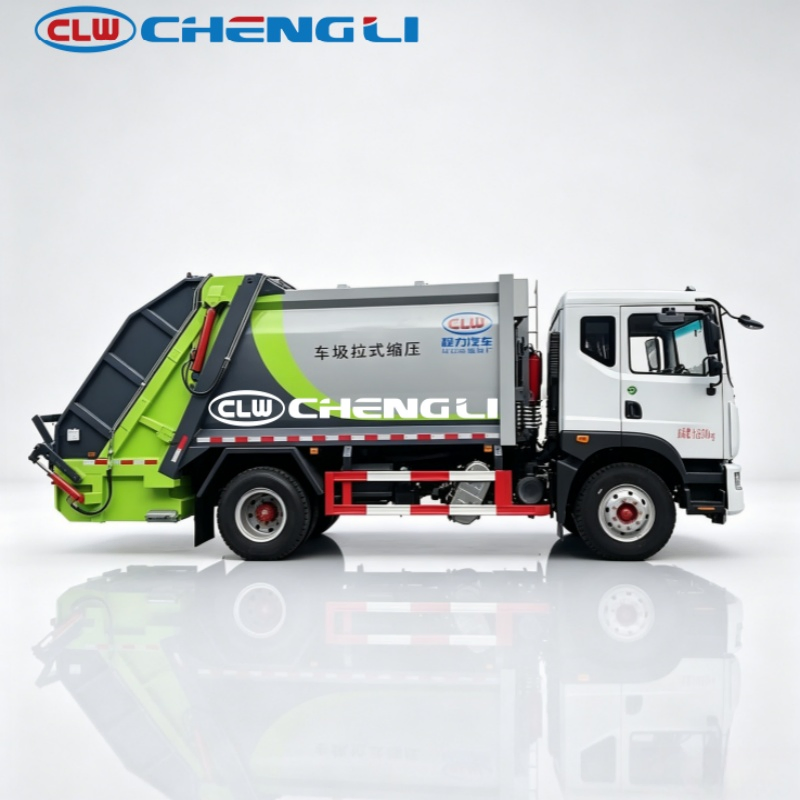
The following CLW examples are specific configurations, not minimum or maximum dimensions for every vehicle in a family. All linear values are in metres and volume is in cubic metres. For the four-axle example, the wheelbase entry gives successive axle spacings; it is not a turning radius or a single front-to-rear measurement.
| Configuration | Length (m) | Width (m) | Height (m) | Wheelbase / axle spacings (m) | Volume (m³) |
|---|---|---|---|---|---|
| 9 m³ rear-loader compactor | 7.530 | 2.360 | 3.000 | 4.700 | 9 |
| 25 m³ rear-loader compactor | 11.660 | 2.550 | 3.680 | 1.950 + 4.425 + 1.400 | 25 |
| Dongfeng 9.5 m³ electric compactor | 7.370 | 2.350 | 2.800 | 3.800 | 9.5 |
| Dongfeng 13 m³ electric compactor | 8.130 | 2.550 | 3.500 | 3.950 | 13 |
| Dongfeng 3 m³ hook-lift configuration | 5.620 | 1.750 | 2.300 | 3.308 | 3 |
How does overall length affect collection access?
Length affects how much straight space the vehicle occupies at a collection point, in a waiting area and inside a parking bay. It also matters when positioning the rear loader next to bins or aligning a container carrier for exchange. Include the working position, rather than checking only whether the cab can enter.
The JMC tipping-truck comparison illustrates why a higher model number need not mean a longer truck: its catalogue contains several complete dimensional options. Keep each option’s length, width and height together in the access review.
Compare the front and rear overhangs as well as the overall length. A rear assembly can extend beyond the chassis, and its movement or approach to an obstacle needs a separate check. Use a dimensioned complete-vehicle drawing to relate these parts to the proposed chassis. Do not estimate overhangs from the perspective of a sales photograph.
Does the width figure include mirrors and working equipment?
Ask what the stated width measures. Body width alone does not describe every projection, mirror position or movement during collection. Record the clear opening between the actual obstacles and identify which parts of the truck must pass through it in their approved travel arrangement.
At the collection point, check the bin, lifter and operator positions separately. Side-lifting equipment may need room beside the truck even when its travel configuration fits a gate. Keep pedestrians, parked vehicles and roadside obstructions in the route assessment. Do not make a narrow passage acceptable by assuming required visibility equipment can simply be removed.
Which height should be compared with a gate or bridge?
Use the highest point of the complete vehicle in travel condition. Check body equipment, roof fittings and any specified accessories on the actual build. A chassis-cab height is not the height of a finished compactor, while the height of a loaded detachable container can determine the carrier's complete travel envelope.
Survey the route under bridges, gates, canopies, overhead services and trees. Record the location, clear opening and approach conditions. Uneven ground, gradients and the vehicle's attitude can change the clearance during passage. Select a suitable allowance through the route assessment and applicable requirements; the table does not establish a universal clearance margin.
What does wheelbase tell a buyer?
Wheelbase helps describe the chassis layout and the space available for body mounting. On multi-axle chassis, the series of axle spacings needs to be read with the axle arrangement. Preserve the separate spacings in the comparison rather than converting them into an unexplained single number.
Wheelbase also influences manoeuvring, but it cannot establish the turning circle on its own. Steering geometry, axle arrangement, vehicle width and overhangs contribute to the path of the complete vehicle. Ask for the relevant turning or swept-path information for the proposed build. A different chassis with similar body volume may behave differently at the same entrance.
Why must travel space and working space be separate?
A vehicle that fits while travelling may need a larger envelope when collecting or unloading. A rear loader needs access to the loading interface and the specified unloading movement. A hook lift needs a suitable container-exchange area. A skip loader needs room for its lifting arrangement, support equipment and the skip itself.
Review the operating drawings and instructions for the actual mechanism, including movement, clearances, support positions and ground conditions. The compactor, hook lift and skip loader ranges address different collection systems. No travel-height figure should be reused as the required overhead clearance throughout every loading or tipping operation.
How should turning and reversing be assessed?
Survey the complete approach, not just the narrowest opening. A truck may pass through a straight gate but be unable to turn into it from a confined lane. Include corners, gate setbacks, parked vehicles, turning areas and places where reversing might be required. Use the proposed vehicle's swept path to review those conditions.
Plan the interaction with people as well as the geometry. The UK HSE guidance on waste-vehicle transport highlights advance route assessment, pedestrian environments and reducing reversing. These are useful planning considerations; the buyer must organise the route and operating method for the actual site and destination.
Which container dimensions need their own check?
For detachable-container vehicles, obtain the container's overall dimensions, loaded mass and lifting-interface details. A container's nominal volume does not identify its length, frame geometry, hook height or lifting points. Two containers with the same cubic capacity can require different mounting or handling arrangements.
Match the container to the proposed lifting system and chassis. Check the complete loaded travel condition and the space needed to position and exchange it. Include clearances around stabilisers or support equipment where fitted. Existing containers should be measured and identified individually rather than described only as a small or large bin.
Can dimensions tell you how much waste the truck carries?
Not by themselves. External dimensions, nominal body volume and permitted waste payload describe different limits. Compaction does not make the weight disappear. A roomy body can reach a mass or axle limit before its nominal volume is filled, depending on the material and loading pattern.
Read the garbage-truck weight and axle-load guide alongside the capacity and compaction guide. Select dimensions around access and the working envelope, then check usable capacity against the waste and complete configuration. Avoid selecting the largest box that can just squeeze through a gate.
What should be checked at the depot and delivery point?
Compare the truck with parking bays, workshop access, washing areas and the unloading location. Include room for the operator, maintenance access and any specified equipment movements. A bay long enough for travel parking may still be unsuitable for lifting a body, opening a rear assembly or removing a container.
For transport, provide the agreed shipping configuration and complete dimensions, including accessories or separately shipped equipment where applicable. Do not assume that a road-travel envelope is the same as the shipping arrangement. Have the carrier and relevant receiving parties assess the actual vehicle and proposed loading method rather than promise that a particular transport format will fit.
How can a route survey become a useful purchasing brief?
Record measurements with photographs, locations and a description of the operating task. Distinguish a clear opening from a nominal building dimension. Show the approach direction and any change in level. A marked sketch can be more useful than a long list of measurements without a shared reference point.
| Location or task | Information to provide | Vehicle information to compare |
|---|---|---|
| Gate or confined lane | Clear width, approach and obstructions | Complete width and swept path |
| Overhead restriction | Clear height and approach level | Complete travel height |
| Collection point | Bin position, operator area and obstacles | Lifter movement and working side |
| Container exchange or unloading | Ground, overhead and surrounding space | Mechanism envelope and support arrangement |
| Depot or workshop | Bay opening and access requirements | Travel dimensions and service access |
Review these measurements with the proposed body and chassis together. The chassis and body matching guide connects the layout discussion to mounting and load requirements. Retain the agreed drawing revision so that a change of chassis or equipment also triggers a review of the affected access dimensions.
Does LHD or RHD change the dimensional review?
Driving position is part of the complete configuration. Include mirrors, visibility, operator access and the collection-control side when comparing the proposed LHD or RHD build. A steering-side label alone does not establish that the working arrangement suits the kerb or collection points on your routes.
The full RHD build guide and LHD/RHD buyer guide explain the related specification questions. Use the actual layout and destination requirements, then review the dimensions of that build. Do not assume two variants are identical in every projection or working movement.
What should you send CLW for a dimension-based proposal?
Send the destination, quantity, waste stream, collection method and desired body or container volume. Add measured route restrictions, the unloading arrangement and existing bin or container details. Specify LHD or RHD and any chassis preference. Explain which dimensions are fixed constraints and which parts of the operating plan can change.
Request a garbage truck configuration with the measurements and sketches. Ask for the proposed complete-vehicle drawing, the separate operating envelope and the relevant capacity and mass limits. This connects a size comparison to a truck that can reach the collection points and perform the required work.
Questions buyers ask
Is there one standard garbage truck width or height?
No. The table compares specific CLW configurations. Check the complete vehicle, accessories, destination requirements and actual travel envelope for the build being purchased.
Can I calculate turning radius from wheelbase alone?
No. Steering geometry, axle arrangement, width and overhangs also matter. Use the proposed complete vehicle’s turning or swept-path information for the actual approach.
Does travel height provide enough clearance for unloading?
Not necessarily. Loading, lifting and unloading can create a different operating envelope. Review the mechanism drawings, instructions and site conditions separately.
Are the five configurations’ volumes their permitted waste payloads?
No. Cubic metres measure volume, not mass. Check the waste characteristics, complete-vehicle mass limits, axle loads and rated equipment capacity alongside body or container volume.