
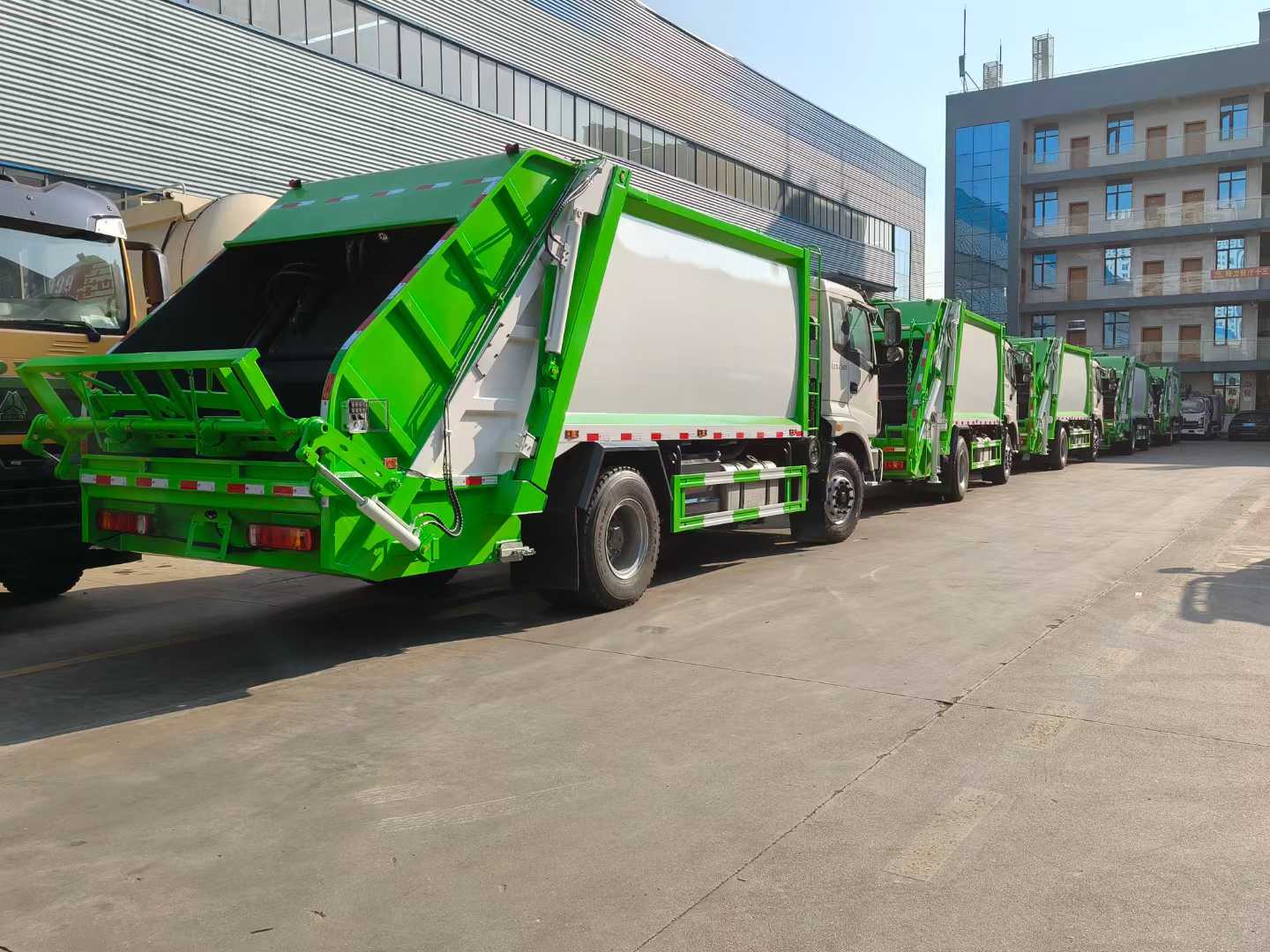
What does compaction change, and what remains limited?
Compaction changes how much space a suitable waste load occupies. By increasing the mass contained in each cubic metre, it can make better use of a body that would otherwise fill before reaching its available payload. It does not increase the complete vehicle's permitted gross mass or the permitted load on an axle.
A dump truck generally receives material into a tipping body and discharges it by raising that body in suitable operating conditions. A garbage compactor adds a loading and packing system selected for the waste stream. The comparison therefore includes collection equipment and unloading arrangements as well as the box that holds the load.
How do the four main purchasing questions compare?
| Question | Compactor configuration | Dump or tipping-body configuration |
|---|---|---|
| Waste carried per trip | Depends on achieved in-body density, usable volume and mass limits. | Depends on loose or loaded density, usable volume and mass limits. |
| Cost per delivered tonne | Include collection, packing, travel, unloading and support costs. | Include loading, travel, tipping, containment and support costs. |
| Liquid and odour management | Examine body closures, liquid handling and cleaning provisions. | Examine the selected body, closures, cover and discharge arrangement. |
| Purchase comparison | Compare the complete chassis, collection body and lifting equipment. | Compare the complete chassis, tipping body and required equipment. |
Neither column establishes a universal winner. An existing bin network, a dense material stream or a receiving facility's unloading rules may decide the practical choice before a theoretical volume calculation does. State these constraints at the beginning of the enquiry.
Which figures do you need before calculating capacity?
Record the intended body volume, a realistic planning fill fraction, the waste density in the relevant loaded condition and the available waste payload of the completed vehicle. Keep density assumptions separate from body specifications. The same material can behave differently with moisture, composition and the collection method.
For the payload comparison, account for the body, working equipment, crew and carried items, and check load distribution. A heavier packing installation can change the mass available for waste. The GOV.UK overloading guidance illustrates why gross and axle limits require separate attention; destination limits must be established for the actual order.
What does a transparent 10 m³ example show?
Use the following hypothetical inputs for the same compressible material. Assume each completed vehicle has a 10 m³ body, a 90% planning fill fraction and 4 t of available waste payload after other operating masses. Assume a loose loaded density of 150 kg/m³ and an achieved compacted density of 450 kg/m³. These inputs describe this calculation, not typical values for every waste stream or ratings of the photographed trucks.
| Input or result | Uncompacted scenario | Compacted scenario |
|---|---|---|
| Body volume × planning fill | 10 × 0.90 = 9 m³ | 10 × 0.90 = 9 m³ |
| Assumed loaded density | 150 kg/m³ | 450 kg/m³ |
| Volume-derived waste mass | 9 × 150 ÷ 1,000 = 1.35 t | 9 × 450 ÷ 1,000 = 4.05 t |
| Assumed available waste payload | 4 t | 4 t |
| Waste mass after the payload ceiling | 1.35 t | 4 t |
The density ratio in the example is 450 ÷ 150 = 3. The usable mass ratio is approximately 4 ÷ 1.35 = 2.96 because the compacted scenario reaches its assumed payload ceiling. This is why a density or compression ratio should not be copied directly into a promise of additional legal payload.
For a hypothetical 27 t batch, those planning loads imply 20 loaded journeys at 1.35 t or 7 at a maximum of 4 t, with a partly filled final journey in the latter case. These are journey counts, not the number of trucks needed in a shift. Include cycle time before turning them into a fleet plan.
How should you compare cost per tonne?
For a defined period, divide the full attributable cost by the tonnes actually delivered. For a transport-only comparison, the basic relationship is complete-trip cost divided by the actual delivered load. Use the same boundary for both vehicles: departure, collection or loading, travel, waiting, unloading and return.
Add crew time, energy or fuel, routine maintenance, cleaning, tyres and the cost treatment used by your organisation for vehicle ownership. If a loader or another vehicle is required, include its work too. Compare the number of completed trips and actual loads, not a theoretical maximum that the route cannot achieve.
Keep measured inputs and assumptions identifiable in your working calculation. Change one assumption at a time to see whether the conclusion depends on density, travel distance or unloading time. Compaction has a clearer capacity argument when volume is the constraint; an operation already constrained by mass, access or available time needs a different assessment.
What changes on a short route or a long haul?
On a short route with a nearby receiving facility, time spent packing, presenting bins or preparing to unload may account for a large part of the cycle. Avoiding one unloading visit may release less travel time than it would on a longer haul. Conversely, a distant receiving facility can make the carried load more influential in the transport comparison. There is no universal distance at which one vehicle becomes the better purchase; collection access and the receiving operation still matter.
Build the worksheet from comparable operating records. Identify the waste mix, collection frequency, actual load weights, loaded and empty travel, waiting and unloading times. Keep peak demand separate from an ordinary day, and compare vehicles within the same service period. If density or another input is assumed, retain that assumption beside the result and examine a reasonable alternative scenario. This makes the purchasing discussion more useful than applying a nominal compression ratio to an annual savings claim, and helps identify which operating measurement would most improve the decision.
When is a compactor a useful starting point?
Consider the compactor truck range where the material is suitable for the specified packing mechanism and the collection system needs that arrangement. Household or similar compressible waste is a common subject for this discussion, but the actual mix, bin interface, liquid content and receiving requirements belong in the brief.
CLW’s Foton-based 16 m³ compactor combines a waste body, loading unit, push plate, hydraulic drive and electrical controls. This is an example of the equipment purchased alongside the chassis. The 16 m³ figure belongs to that configuration, while the calculation above uses its own stated 10 m³ body-volume assumption. Keep model specifications and planning inputs in separate columns when comparing proposals.
Use the compactor working-system explanation to understand the role of the loading and packing equipment. Define the bin fleet and unloading method before comparing alternative complete vehicles.
When should tipping or detachable containers be considered?
For material that is already dense, increasing in-body density may add little usable mass before the truck reaches a weight constraint. Construction material also raises questions about impact, abrasion, loading equipment and the receiving site. Choose the body and collection method around the actual stream rather than assuming every material benefits from a refuse-packing mechanism.
The JMC tipping-truck comparison provides two published hydraulic-tipping configurations to review against this workflow. Check their actual body and loading equipment before treating them as substitutes for a compactor.
Review a sealed tipping-body waste truck where that configuration suits the task, and use the construction-waste vehicle selection page for the relevant brief. If the customer fills detachable containers, include container exchange and the matching lifting equipment in the comparison instead of limiting the enquiry to fixed bodies.
How should liquid, odour and cleaning requirements be specified?
Describe the material and the required containment, closures, liquid-collection arrangements and cleaning access. A closed-looking body should not be treated as a guarantee of airtightness or suitability for a separate liquid load. Inspect the proposed details and plan cleaning around the collection and receiving process.
Also include the people and vehicle movements around loading and discharge. HSE's collection guidance highlights moving equipment and transport hazards. The equipment manual and site procedures govern safe operation; this comparison is a purchasing and planning aid.
How should purchase price and LHD/RHD enter the decision?
Compare written offers for the same destination, waste task and vehicle quantity, identifying chassis, body, bin handling, documents and the agreed support scope. Purchase price and operating cost are different parts of the decision. Avoid comparing a carrier-only price with a complete compactor order as though the equipment scope were identical.
CLW offers tiered pricing: higher order quantities receive lower unit prices, and large orders can be delivered in stages. Request the price and delivery arrangement for your defined configuration and quantities, with batch timing included in the order discussion.
State left-hand drive or right-hand drive, the intended working side and the destination requirements. The RHD configuration guide and LHD/RHD buyer guide help organise this part of the specification. Driving position alone does not establish the body layout or market acceptance.
What should you send CLW to compare configurations?
Send the country, quantities, waste description, daily mass and volume, existing bin or container drawings, loading and unloading methods, route cycle, driving position and chassis preference. Include measured access restrictions, specified emissions requirements and the support scope you need. Use the capacity and compaction-ratio guide to keep volume and mass distinct, then discuss your garbage truck order or email [email protected].
Questions buyers ask
Does a 3:1 compaction ratio mean three times the legal payload?
No. In-body density and permitted vehicle mass are different constraints. Available waste payload, axle loads, usable volume and the actual material determine the carried load.
Is a compactor always cheaper per tonne than a dump truck?
No universal cost result applies. Compare actual delivered loads and the full collection cycle, including ownership, crew, energy, maintenance, cleaning and any other equipment required.
Can a dump truck and a compactor with equal body volumes carry equal waste mass?
Not necessarily. Loaded density, available payload, working equipment and load distribution can differ. The article’s equal-payload comparison is explicitly an illustrative scenario.
Are the 10 m³ example inputs CLW vehicle ratings?
No. They are hypothetical planning inputs used to show the calculation and its payload ceiling. Select a vehicle using its complete configuration and the operating requirements.