
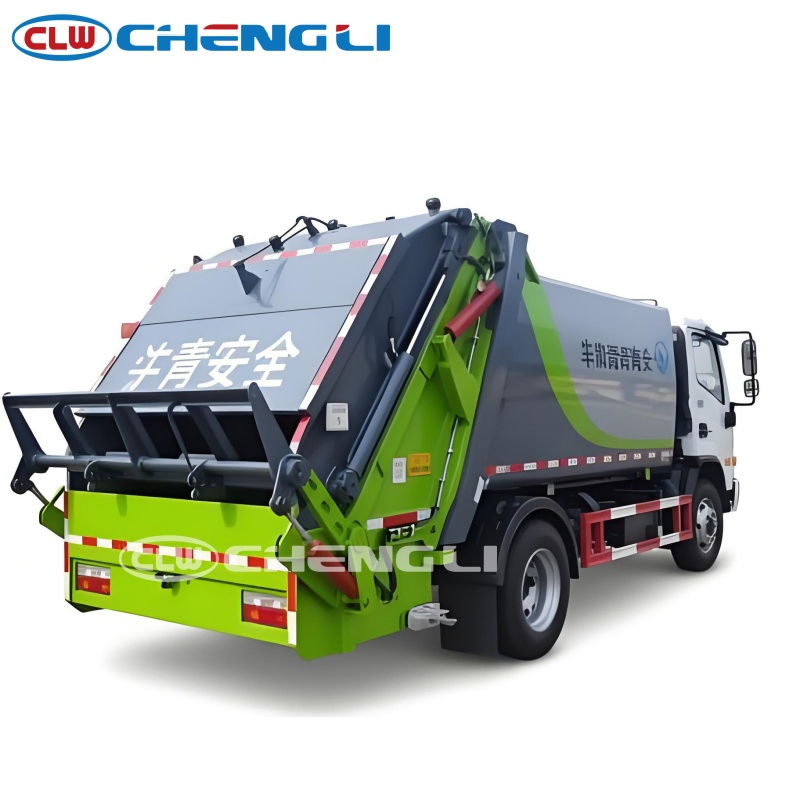
What happens between the bin and the storage body?
On a typical rear-loading compactor, the collection interface delivers waste into a hopper at the back. A compatible bin lifter may tip a container into that opening. The packing mechanism then gathers material from the hopper and transfers it into the storage body. These are related functions, but lifting a bin and compacting its contents are different operations.
Think of the body as the load space and the hopper as the receiving area. Repeated packing makes room for further collections; it does not make the load disappear or increase the vehicle's permitted mass. The complete collection system also needs a suitable way to discharge at the receiving facility.
- Bin and pickup interface.
- Rear receiving hopper.
- Sweep/packing mechanism and moving carrier.
- Storage body for the collected waste.
- Ejector panel, where this discharge arrangement is fitted.
What do the sweep plate, slide and ejector each do?
| Part or assembly | Main role | Useful purchasing check |
|---|---|---|
| Bin lifter | Transfers a compatible bin's contents to the hopper | Pickup profile, bin mass and operating clearance |
| Hopper | Receives the incoming material | Loading arrangement and access for the actual waste stream |
| Sweep or packer blade | Gathers and moves waste during the packing cycle | Mechanism drawing and the terms used in its manual |
| Slide or moving carrier | Moves the packing assembly through its designed path | Guide arrangement, wear points and service access |
| Ejector panel | Pushes the load out in an ejector-type body | Discharge sequence, rear working space and receiving facility |
Different builders use packer blade, sweep panel and packing plate differently. In a sweep-and-slide arrangement, a moving blade and carrier work together to gather material and move it into the body. Other mechanisms use different paths. Two quotations with different part names may describe similar functions; two with identical names may still specify different equipment.
Does the packer simply crush everything in the hopper?
No. Compaction depends on the material's ability to rearrange, deform and occupy less space. Loose packaging and dense, rigid material do not respond alike. The waste stream must be suitable for the specified body and mechanism; a general refuse compactor is not a universal machine for liquids, hazardous materials or every bulky object.
The packing system works against resistance from material already in the body and the particular body design. As loading continues, the available payload or an axle limit can become the constraint before all nominal space is used. Compare the complete vehicle with the intended material, rather than interpreting repeated packing as permission to keep adding mass.
How do hydraulic pressure and compaction ratio differ?
Hydraulic pressure describes the fluid pressure driving an actuator. Compaction ratio compares the volume of the same quantity of waste before and after compression under stated conditions. They measure different things. A pressure figure by itself does not establish waste density, tonnes per load or a guaranteed reduction in volume.
Cylinder area and mechanism geometry influence the force delivered at a working component. Material, loading pattern and usable body space influence the result. When comparing a pressure or ratio, request its units, measurement conditions and applicable configuration. The capacity and compaction-ratio guide explains the volume-to-mass distinction for purchasing calculations.
Where does the hydraulic power come from?
The body needs a suitable hydraulic power supply, control valves, actuators and associated pipework. The proposed chassis and body must be coordinated around how this supply is driven and controlled. Do not assume that an engine-driven installation and an electric chassis use the same arrangement, or that identical body volume means identical power requirements.
Ask how the proposal distinguishes traction energy from body-working energy, which functions can operate together and what operating information is available to the crew. This is a configuration discussion, not a reason to alter pressure settings. Model-specific adjustments and troubleshooting belong to the relevant technical instructions and qualified service personnel.
How is the compacted load discharged?
In an ejector-type rear loader, the rear opening and ejector panel provide the discharge path. The panel moves the load toward the rear when the equipment is in its specified unloading configuration. Other bodies may use a different discharge method. Confirm the actual arrangement instead of assuming every compactor tips its complete body.
Include the receiving facility in the purchase brief: approach, ground conditions, overhead clearance and space behind the truck all matter. A vehicle's parked dimensions do not describe its full working envelope. Describe the equipment that receives the waste and whether a station interface restricts the unloading position.
Which controls and maintenance information should buyers examine?
Review the equipment manual, control identification, guarding, emergency-stop arrangement and safe maintenance access for the proposed build. Ask how operators are trained and how faults are reported. An emergency stop is important, but it does not replace secure isolation for cleaning, blockage clearance or maintenance involving moving components and stored energy.
HSE's waste-machinery guidance highlights the hazards of intervention while machinery is running and the need for isolation and training. This explanation of component functions does not provide a control sequence. Use the particular vehicle's instructions and the site's competent operating procedures.
Does LHD or RHD change the compactor specification?
Driving position and body-working layout need to be considered together. Identify the intended collection side, control locations, crew movements and bin presentation. Compare the rear-loader configurations with your bin and lifter interface, rather than selecting the body from its capacity alone.
The full RHD build guide and LHD/RHD buyer guide set out the related enquiry questions. Steering position does not itself demonstrate destination approval or a particular loading-side arrangement.
What should you send CLW for a compactor quotation?
Send the destination country, quantity, waste description, loading method, bin drawings or photographs, expected load mass, route restrictions and unloading arrangement. Include LHD or RHD, chassis preferences and specified emissions requirements. Ask for the body mechanism, controls and technical documents to be identified in the proposal. Discuss your garbage truck purchase with these details so the chassis, collection interface and compactor can be considered together.
Questions buyers ask
Are the packer blade and ejector the same part?
Usually these names identify different functions: the packer moves material into the body during collection, while an ejector-type body uses a panel to discharge the load. Check the drawing and terminology for the particular mechanism.
Does higher hydraulic pressure mean a higher legal payload?
No. Hydraulic pressure does not increase permitted gross or axle mass. Available waste payload depends on the complete vehicle and its loading limits.
Does every compactor unload by tipping the body?
No. Some use an ejector arrangement, while other configurations discharge differently. Specify the unloading system and check its working envelope against the receiving site.
Can the same compactor lift any bin of a given volume?
Bin volume alone does not establish compatibility. The pickup profile, dimensions, loaded mass and lifter arrangement must correspond.