
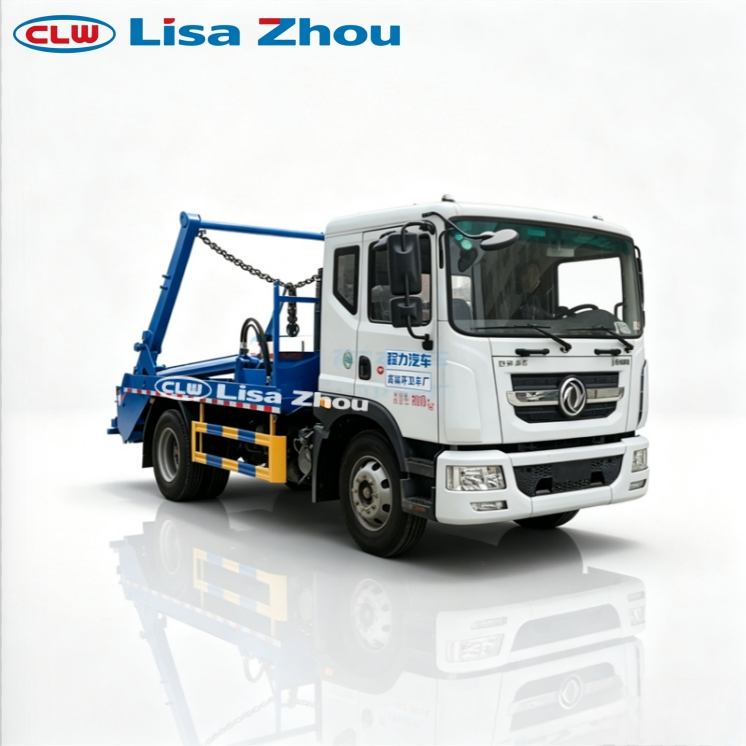
What does a skip lorry do?
A skip lorry collects a detachable waste container as a unit, rather than emptying small bins into a permanently fitted compactor. A container can remain at a collection point while another is transported. This separates its filling time from the carrier’s transport work, provided the fleet has compatible containers, suitable exchange locations and an achievable receiving-facility schedule.
For a purchase, describe the waste and collection arrangement before naming a truck size. The CLW skip loader range concerns the container-handling vehicle. A request for a skip lorry should also identify whether containers are supplied or already owned. Neither a generic truck name nor a picture of an empty platform defines the included container or permitted working load.
Are chains and lifting arms different skip systems?
Often they are parts of the same system. The hydraulically moved arms provide the movement; chains connect those arms to appropriate lifting points on the skip. That differs from a rigid hook engaging a purpose-designed pickup on a hook-lift container. Identify the actual mechanism instead of ordering a chain truck without specifying how its arms and container work together.
Arm geometry can differ. The Hyva skiploader overview, for example, distinguishes fixed, telescopic and knuckle-arm equipment. This establishes different arm families, not CLW component specifications or a promise that every variant is available for your chassis. Compare the proposed system’s drawings and operating limits; do not borrow another manufacturer’s capacity or control arrangement.
How should you describe skip size?
State nominal internal volume separately from the external dimensions needed for handling and transport. Include length, width, height, lifting-point positions and any doors or covers. Sloping walls and the allowed fill line mean a simple outside rectangular calculation can overstate usable capacity. Ask how the proposed skip’s volume is measured and which drawing revision defines its shape.
Use cubic metres first in an international enquiry. If an existing skip is described in cubic yards, establish the actual volume and dimensions rather than matching the number alone. The following examples use the exact international-yard conversion, rounded for reading. They are unit conversions, not CLW container sizes, lifting ratings or confirmation that a matching truck is available.
| Volume in m³ | Approximate volume in yd³ | Still needed for vehicle matching |
|---|---|---|
| 4 | 5.23 | Actual external geometry and lifting points |
| 6 | 7.85 | Container empty mass and loaded condition |
| 8 | 10.46 | Arm clearance, chain arrangement and restraints |
| 10 | 13.08 | Equipment limits, vehicle and axle assessment |
Why can a skip reach its load limit before it looks full?
Volume measures space, while mass determines how much load the equipment and vehicle must carry. A dense waste stream can reach a permissible mass before filling the container. A bulky lightweight stream may use the available space first. Actual material composition, moisture and the container’s own mass belong in the assessment; the advertised cubic capacity is not a tonnes rating.
Define the intended waste load and obtain representative weights, then consider the empty skip as part of the lifted and transported load. Do not infer a permitted rubble load from a container’s volume or a truck’s gross mass. The capacity and density guide explains why cubic metres and tonnes must be kept separate instead of using an unsupported universal conversion.
Which lifting-capacity figure matters?
Ask for the capacity and conditions of the actual handling system with the proposed container. Reach, container position, arm configuration and the equipment’s operating geometry matter to the applicable limit. A capacity label without its associated conditions is incomplete. Do not assume the same permitted load for arms retracted, extended or in another working position merely because the same truck is used.
Separate lifting capacity from the complete vehicle’s road payload, gross mass and axle limits. The empty skip, body equipment and mounting all affect the usable vehicle load. Request a loaded mass assessment for the chosen chassis and container. A high lifting-system rating does not give permission to exceed the vehicle’s limits, and vehicle gross mass does not state the lifting system’s capacity.
What should be checked about chains and lifting lugs?
Identify chain assemblies, connections and the skip’s designed lifting points together. Obtain the required ratings, arrangement and identification for the specified load geometry. Do not assume that dividing the load by the number of visible chains establishes a safe chain rating: load distribution and chain angle depend on the actual arrangement. A spare chain that looks similar is not sufficient evidence of suitability.
Provide clear photographs and dimensioned drawings of existing lugs, including their positions relative to the skip. Identify repairs or modifications rather than treating the whole pool as identical. Agree equipment-specific inspection, maintenance and replacement requirements from the delivered instructions. This is purchasing information, not a procedure for improvised rigging or permission to use damaged chains or altered lifting points.
How do fixed and telescopic arms affect the enquiry?
A fixed-arm and a telescopic-arm proposal should be compared by their actual working envelopes and compatible skip range. Extension changes the geometry that must be assessed; it is not an automatic increase in permissible load. Ask what happens at the required pickup position and site restrictions. Keep capacity conditions and container dimensions with each proposed arrangement rather than comparing only arm reach.
The double-arm skip truck category and telescopic skip truck category organize enquiries by arrangement. Category names are not a guarantee that your required configuration is immediately available. The container compatibility guide helps define arm clearance, lifting points and skip geometry before equipment and chassis are selected together.
What must the exchange site accommodate?
Measure the approach, container position, loading movements and intended unloading area. Include overhead obstructions, nearby structures and room for the specified support arrangement. A container fitting on a parking space does not show that the lorry can safely pick it up there. Ground conditions, gradients and interactions with people and other vehicles also need assessment for the actual work method.
Use the selected equipment’s instructions to establish working limits and support requirements. Do not copy a permissible slope or stabilizer layout from an unrelated truck. UK HSE waste-transport guidance highlights route assessment, pedestrian separation and reducing reversing. These are useful planning considerations, not approval for a particular loading site or a substitute for trained operation.
How should tipping and transport restraint be specified?
State whether the operation deposits the entire skip or discharges its contents, and describe how the receiving facility accepts the load. Doors, tipping arrangements and restraint functions depend on the selected equipment and container. A skip carried securely on the road still needs a correctly specified unloading arrangement. Do not infer every movement from a photograph of raised arms.
Define transport retention and load containment separately from the lifting connection. Include any cover requirements and access to the skip’s doors. The supplier’s quotation should identify these items rather than leave them as assumed accessories. An open skip does not inherently provide liquid containment, and the lifting system does not make an unsuitable container appropriate for wet or special waste.
How do LHD and RHD change a skip-lorry brief?
State destination and driving position, then discuss visibility, operator access and control locations for the chosen chassis and equipment. The working side and collection layout need consideration with the sites involved. Do not assume the pictured cab proves RHD availability or that moving the steering wheel defines a complete waste-vehicle configuration.
The full RHD build guide and LHD/RHD destination guide explain the related questions. Treat destination requirements and registration arrangements separately from steering position. Neither a British-style name such as skip lorry nor a regional term establishes a vehicle’s road approval or suitability for every market.
How many skips and daily trips should you plan?
Count containers left at sites, containers waiting for unloading or cleaning and those needed for exchanges. Relate that pool to complete carrier cycles, including driving, access, lifting, securing, queues and return travel. No fixed skips-per-truck ratio applies to all routes. More containers can provide filling capacity without creating more available vehicle hours.
Measure representative rounds and the receiving facility’s operating hours before deciding vehicle quantity. Record which skips are compatible with each proposed carrier so maintenance or substitutions do not strand containers. A higher nominal skip volume may not reduce trips if mass, access or facility constraints are limiting. Compare the whole operation instead of assuming a larger container always improves productivity.
What should you send CLW for a skip-lorry quotation?
Send destination, vehicle and skip quantities, waste description, nominal volume and actual loaded masses. Include dimensioned skip drawings, lifting lugs, chain arrangement, external dimensions, door or cover details and site restrictions. State the unloading method, driving position, chassis preference and destination requirements. Identify whether the order includes new containers or must accommodate an existing pool.
Request a matched skip lorry and container quotation with this information. Ask for the complete chassis, handling system, compatible skip range, restraints and included documents to be defined. Keep the agreed drawings with repeat purchases. The useful specification connects container size and mass to its lifting arrangement and carrier, rather than buying on cubic metres or a headline lifting figure alone.
Questions buyers ask
Are chains an alternative to lifting arms on a skip lorry?
On many swing-arm skip lorries they work together: chains connect the skip to the moving arms. Identify the proposed arrangement and lifting points rather than treating chain and arm as mutually exclusive truck types.
Does a 10 m³ skip mean the truck can carry 10 tonnes?
No. Cubic metres measure volume. The permissible load depends on actual waste mass, empty skip mass, handling-system limits, complete vehicle mass and axle limits.
Can I assume the same lifting load with telescopic arms fully extended?
No. Use the conditions and capacity information for the selected equipment and actual working geometry. Arm extension must not be treated as an automatic increase in allowable load or reach under any load.
What measurements are needed for an existing skip?
Provide external dimensions, lifting-lug positions and geometry, empty mass, loaded condition, doors, covers and transport-restraint features. Identify the drawing revision and any repairs or changes to the lifting interfaces.