
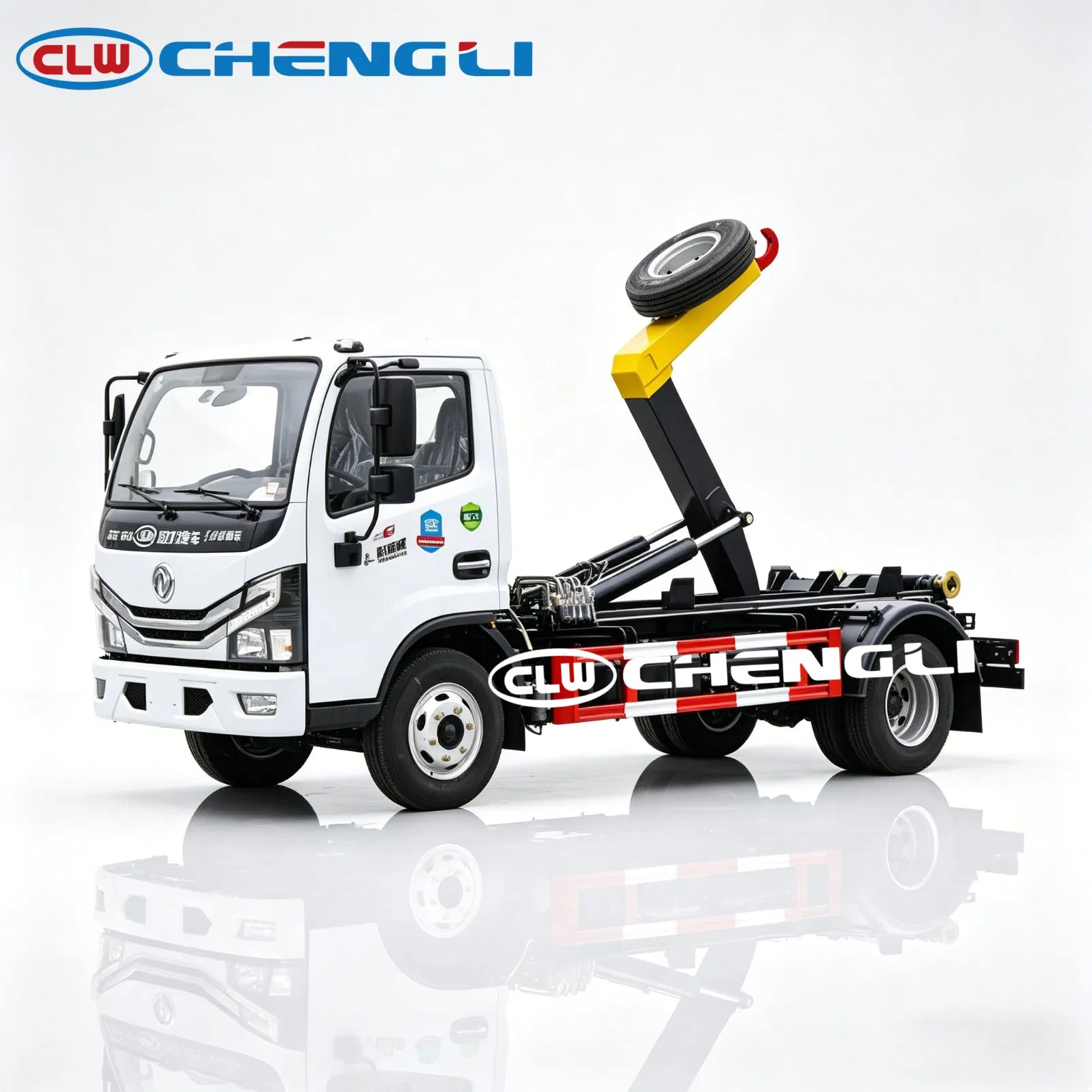
What does RoRo bin lorry mean in a waste enquiry?
RoRo abbreviates roll-on roll-off. In waste collection, it describes transport of a removable container rather than the emptying of every small bin into a permanently fitted body. The container can remain at a site while it is filled. The carrier later collects it or exchanges it for another compatible container, subject to the actual site and equipment arrangement.
The term appears in Malaysian waste-container services: Shah Alam City Council’s construction-waste bin page calls them roll-on roll-off containers. Singapore’s NEA collection guidance instead identifies hooklifts and open-top containers. Use these names to understand an enquiry, not as evidence that every container in either market uses an identical interface. This guide concerns purchasing vehicles, not booking local bin rental.
Does the name tell you which lifting mechanism is fitted?
No. Obtain a picture and equipment description identifying the actual arrangement. A hook-equipped RoRo lorry uses a hydraulic arm and matching container pickup. A general roll-off description may also refer to cable equipment. Neither abbreviation states hook height, vehicle class or permissible load. Describe the mechanism explicitly when translating a tender or comparing suppliers from different markets.
Start with the CLW hook lift vehicle range when the required arrangement is a hook carrier. The roll-off versus hook lift comparison explains the naming distinction. A request for a RoRo bin lorry should identify both the carrier and its containers; the vehicle name does not include an unspecified bin automatically.
Which bin size should a buyer specify?
Specify useful internal volume and actual external dimensions separately. Volume describes available space; outer length, width and height affect transport, site access and handling. Sloping walls, internal obstructions and the intended fill level can reduce usable space. A simple length-times-width-times-height calculation applies only to the rectangular internal space being measured, not to every container shape.
The table is a geometry exercise with invented rectangular inside dimensions, not a CLW size catalogue or a recommended container range. It shows why two containers cannot be matched to a truck by cubic metres alone. Real containers need drawings showing external structure, pickup and support interfaces as well as the method used to state their capacity.
| Assumed internal dimensions, m | Geometric volume, m³ | What the result does not establish |
|---|---|---|
| 3 × 2 × 1 | 6 | External dimensions, mass or hook compatibility |
| 4 × 2 × 1.25 | 10 | Usable fill level or lifting capacity |
| 5 × 2 × 1.5 | 15 | Permissible payload or axle distribution |
| 5 × 2 × 2 | 20 | Road clearance or a suitable carrier |
How do fill rate and waste type change the bin choice?
Measure how much material arrives between collections and how it occupies the container. A bulky stream can use the space before reaching a mass limit; a dense load can reach a mass limit while substantial space remains. Wet material also raises containment and discharge questions. Do not choose a larger bin until both the waste load and container construction suit the intended work.
For a hypothetical scheduling example, a nominal 10 m³ rectangular bin used to an assumed 80% fill provides 8 m³ of planning space. At an assumed 4 m³ arrival per day, that represents two days of accumulation. Neither assumption is a loading limit or a permitted storage period. Use measured waste, the actual fill restriction and applicable site arrangements; do not add an unproven compaction multiplier.
How should hook height be measured?
Hook height is an interface dimension, not a synonym for container height. Ask which reference plane and pickup centre the equipment drawing uses, then measure the container to that same convention. State units in millimetres and identify the drawing revision. An overall photograph cannot establish the precise pickup position, its strength or its suitability for the proposed handling mechanism.
Do not order to an assumed universal hook height or copy a value from a visually similar truck. Different equipment and container families need their own dimensional match. If containers already exist, provide each interface drawing before finalizing the carrier. The container compatibility guide brings pickup, rails, rollers and locking details into the same purchase discussion.
What other dimensions belong on the container drawing?
Include container length, supporting members, rear rollers, engagement point and transport locks. Explain where each measurement starts and ends. Identify protruding doors, covers or fittings that affect the operating envelope. The following schedule separates common questions; it is not a substitute for the selected system’s actual dimensions, tolerances and structural requirements.
| Drawing item | Information to provide | Why the buyer needs it |
|---|---|---|
| Pickup geometry | Height, centre position, shape and reference plane | Establish engagement with the selected hook |
| Support and rollers | Rail layout, support surfaces and rear roller positions | Define transfer and loaded support |
| Length and projections | Overall length, doors, covers and other projections | Check carriage and working envelopes |
| Transport restraints | Lock positions and matching container features | Define retention in the transport condition |
| Mass and distribution | Empty container and intended loaded condition | Check hoist, vehicle and axle limits |
| Identification | Container number, drawing and revision | Keep repeat orders and existing bins consistent |
Review the entire container family rather than sampling one convenient bin. Record modifications, repairs or different revisions. An interchangeability list should say which carrier and container combinations are intended to work together. The same advertised volume does not prove that an unmeasured replacement belongs in that list.
How do you establish the waste payload?
Distinguish empty container mass, contents, handling-system capacity and complete vehicle limits. The hook lifts the container and contents together. On the road, the complete loaded vehicle also includes the chassis, hoist and other equipment. A rating attached to any one component does not override the other limits or show how the load divides between axles.
Check the definitions used for quoted empty mass so the container is neither omitted nor deducted twice. Request the proposed loaded weight distribution and equipment operating limits for the actual container geometry. The capacity and density explanation helps separate cubic metres from tonnes. It does not turn a nominal bin volume into a guaranteed legal payload.
How many bins should accompany each lorry?
There is no fixed bin-to-truck ratio for every collection business. Count containers left at sites, containers awaiting unloading or cleaning and those needed for exchanges. Then relate that pool to the lorry’s available transport rounds. A site may fill slowly while the truck serves other sites, but only if enough compatible containers and exchange space exist.
For planning, map each container’s location and expected ready time across a normal day. Include the receiving facility’s opening hours, waiting and any return with an empty container. Buying more bins does not shorten the driving route. Buying another carrier does not solve an incompatible container pool. Treat vehicle quantity and container quantity as separate lines in the enquiry.
What makes a practical exchange site?
Show the approach, container resting area and the full loading and unloading envelopes. Record gates, overhead obstacles, gradient, ground condition and interaction with people or other vehicles. The bin footprint is only one part of the area required. A location that can store the container may still be unsuitable for the carrier’s movements or the intended unloading method.
Describe whether the loaded bin will be removed whole, tipped or connected to other equipment. Check access to doors and covers in that arrangement. Agree the site and work method against the equipment instructions. A smaller bin or narrow truck does not by itself establish an acceptable working area; provide measured restrictions rather than choosing from the appearance of a photograph.
What does an RHD RoRo lorry specification include?
State right-hand drive explicitly where required by the purchase. Malaysia has left-hand traffic, as stated in the Canadian government’s Malaysia driving guidance; Singapore’s official basic driving handbook also sets out keeping left. These traffic-side references do not establish registration or import approval for a particular waste truck.
Define cab, visibility, access, lighting and intended operator/control positions with the chosen chassis and hook equipment. The full RHD waste-truck build guide explains why this is more than steering-wheel position. For any destination, agree the complete configuration and local requirements; do not infer that every pictured CLW model is available in a suitable RHD version.
Which documents and inspections should the order define?
Ask for drawings identifying the carrier-container combination, relevant operating instructions, mass information and parts identification. Agree the required handover, training and inspection scope for the destination and equipment. Inspection requirements are jurisdiction-specific. Singapore’s NEA guidance, for example, specifies annual accredited-workshop inspection of hooklifts and open-top containers; that is a Singapore requirement, not a worldwide certificate held by a proposed truck.
Keep the contractual vehicle scope separate from a local collection operator’s service licence or bin-placement permission. A supplier’s photograph does not establish either. Identify who arranges each destination check and which documents are required for the order. Do not insert a generic warranty period, delivery promise or certification into the specification because another market’s RoRo service uses it.
What should you send CLW for a RoRo vehicle quotation?
Send destination, driving position, vehicle quantity and container quantity. Describe the waste, collection frequency, empty and loaded bin masses, internal capacity and dimensioned interface drawings. Include hook height reference, rails, rollers, locks, site restrictions and receiving method. Identify chassis preferences and destination requirements. State whether new bins are needed or the lorry must work with a defined existing pool.
Request a matched RoRo hook truck and container quotation. Ask for the included vehicle, handling equipment and compatible bin scope to be stated separately. Keep drawings and revisions with the purchase record for repeat orders. A well-defined RoRo enquiry connects the bin that fills at the site with the carrier that can handle and transport it.
Questions buyers ask
Does RoRo mean a particular bin size?
No. It describes removable-container transport, not a universal volume or dimension. State internal capacity, external dimensions, pickup, support, locking geometry and the loaded condition for the actual bin.
Can two bins with the same cubic capacity have different hook heights?
Yes. Cubic capacity describes space; hook height describes the lifting interface. Equal volumes do not establish equal pickup geometry or compatibility with the same carrier.
How many RoRo bins can one lorry serve?
That depends on filling rates, site locations, complete round times, receiving hours and the compatible container pool. Count parked and exchange bins separately from vehicles; no fixed ratio suits every route.
Does specifying RHD prove a truck can be registered in Malaysia or Singapore?
No. RHD identifies the driving position. The complete vehicle and destination-specific import, registration and equipment requirements must be addressed separately; traffic side is not an approval certificate.