
Six cubic yards describes space, not payload
A search for a 6 yard garbage truck usually refers to a body capacity of six cubic yards. Using the international yard, one cubic yard equals 0.764554857984 m³. Six therefore equals 4.587329147904 m³, normally rounded to 4.59 m³ or about 4.6 m³. It is a volume conversion, not a measure of how many tonnes the truck can carry.
Specify cubic yards, written yd³, rather than simply “yards” in a quotation request. Also identify whether the advertised number refers to the main refuse body or another compartment. Hopper capacity, bin capacity and body capacity describe different spaces. Adding them together does not establish usable payload or authorize a heavier load.
Compare nearby metric body sizes
| Cubic yards | Cubic metres | Comparison purpose |
|---|---|---|
| 4 yd³ | 3.06 m³ | Smaller-volume reference |
| 6 yd³ | 4.59 m³ | The requested six-yard size |
| 8 yd³ | 6.12 m³ | Larger-volume reference |
| 10 yd³ | 7.65 m³ | Larger-volume reference |
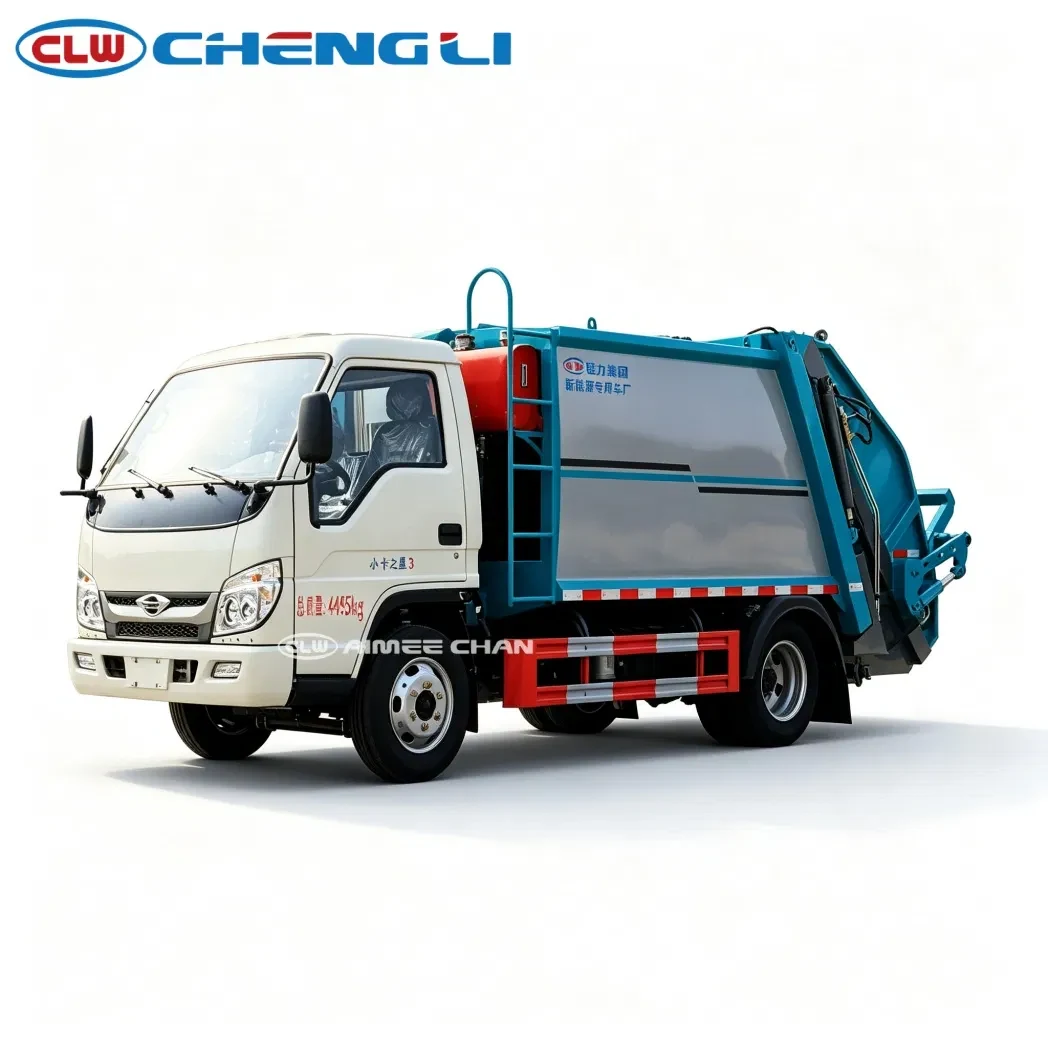
A 5 m³ body is slightly larger by nominal volume than six cubic yards: approximately 6.54 yd³. It is not an exact six-yard body. The pictured CLW Forland 5 m³ mini compactor is a nearby metric configuration, not a six-yard certification or a promise of interchangeable dimensions. Compare its drawing, lifting interface and permitted mass separately.
Estimate service demand before counting households
There is no fixed number of households served by a six-yard truck. Waste per household, collection frequency, commercial stops, material density and the available working day all change the answer. Use weighed rounds or a local waste survey, and distinguish the mass accumulated since the previous collection from an assumed daily generation rate.
For illustration only, suppose 600 households each present 1.5 kg at a collection visit. The total is 900 kg. If the waste occupies 3 m³ after packing in the body, its in-body density is 300 kg/m³. These are chosen planning assumptions, not measured household waste rates or performance figures for the pictured vehicle. The selected truck must have sufficient usable body space and permitted payload for the actual collected mass.
Calculate the volume limit and the mass limit
Consider a hypothetical 4.59 m³ body, a chosen usable-fill allowance of 90%, an assumed in-body density of 300 kg/m³ and a hypothetical permitted waste payload of 1500 kg. Usable space is about 4.13 m³, giving a volume-based mass of about 1239 kg. Under those assumptions, volume would be reached before the 1500 kg payload allowance.
If the in-body density instead became 500 kg/m³, the same space would imply about 2065 kg. The assumed 1500 kg payload would then limit loading first. Neither density is a universal value, and 1500 kg is not a rating of a CLW model in this article. Actual axle limits also apply. See the capacity and compaction explanation before applying a density or compaction factor.
Count complete trips within the working window
Suppose 360 minutes remain for vehicle cycles after other duties, and each complete cycle takes 100 minutes: collecting, travelling, queuing, unloading and returning. Three whole trips fit. Four would require 400 minutes. Under the earlier illustrative volume-limited load of 1239 kg, three trips would move about 3717 kg, provided every other operating and loading condition were satisfied.
This arithmetic is a screening tool, not an output guarantee. A longer queue or collection round changes the result immediately. Measure the busiest day's conditions and account for receiving-site opening hours. Do not recover a missed trip by exceeding payload limits. The fleet calculator can help compare your own workload assumptions; enter the actual standby vehicle count rather than a percentage.
When a small rear loader can fit the operation
A compact collection vehicle can be worth considering where access is the binding constraint and unloading is reasonably close. Examples include a service-road network, a campus or a collection district with restricted entrances. However, the body-volume label does not establish width or turning performance. Survey the route and use complete-vehicle measurements, including the required operating clearances.
Review the mini garbage truck range and rear-loader compactor range using the same route brief. Check the bins already in service before choosing the lifter. If the truck fits the entrance but cannot turn or present its hopper safely, its compact body size has not solved the access problem.
When to compare a larger vehicle or transfer arrangement
Compare a larger body when the small truck would repeatedly leave the route to unload and a larger complete vehicle can still reach the collection points. Compare the complete daily cycle and crew time, not only purchase price per cubic metre. Dense waste may require greater permissible payload rather than simply a larger empty body.
If a larger vehicle cannot enter, investigate a properly planned feeder and transfer arrangement instead of assuming that a larger body can be fitted to the same chassis. Include the authorized receiving location, any additional handling and the onward transport cost. The correct decision may involve different vehicle roles rather than a single size used everywhere.
Describe the required configuration in the enquiry
State “approximately 4.6 m³ body volume” alongside “6 yd³” if the requested size is approximate. If a contract requires exactly six cubic yards, say so and ask how the volume will be defined and accepted. Add daily waste mass, waste type, bins, route dimensions, receiving-site distance, quantity and destination. Driving-position availability depends on the selected chassis and model.
Ask for the proposed body dimensions, permitted masses and compatible loading equipment together. Confirm the commercial scope before comparing quotations. A six-yard search term is a useful starting point; a workable purchase specification connects that volume to the real route, the loading interface and the time available to finish collection.
Apply density and compaction once
If density was measured after the material was packed inside the body, do not multiply the resulting mass by a compaction ratio again. That would count the same reduction in occupied space twice. If you only have loose-waste density, establish a suitable packed-density assumption separately and test it against weighed loads. Keep the body-volume conversion independent of this calculation: six cubic yards remains the same physical volume regardless of waste type.
Questions buyers ask
How many cubic metres are six cubic yards?
Six international cubic yards equal 4.587329147904 m³, normally rounded to 4.59 m³ or approximately 4.6 m³.
Is a 5 m³ body exactly a six-yard body?
No. Five cubic metres are approximately 6.54 yd³. Compare the agreed body-volume definition and complete dimensions.
How many households can it serve?
There is no fixed number. Use local collected mass, collection frequency, waste density, permitted payload and the time for complete unloading trips.
Does compaction increase the permitted payload?
No. Compaction changes occupied volume. The complete vehicle and axle limits still govern permitted loading.