
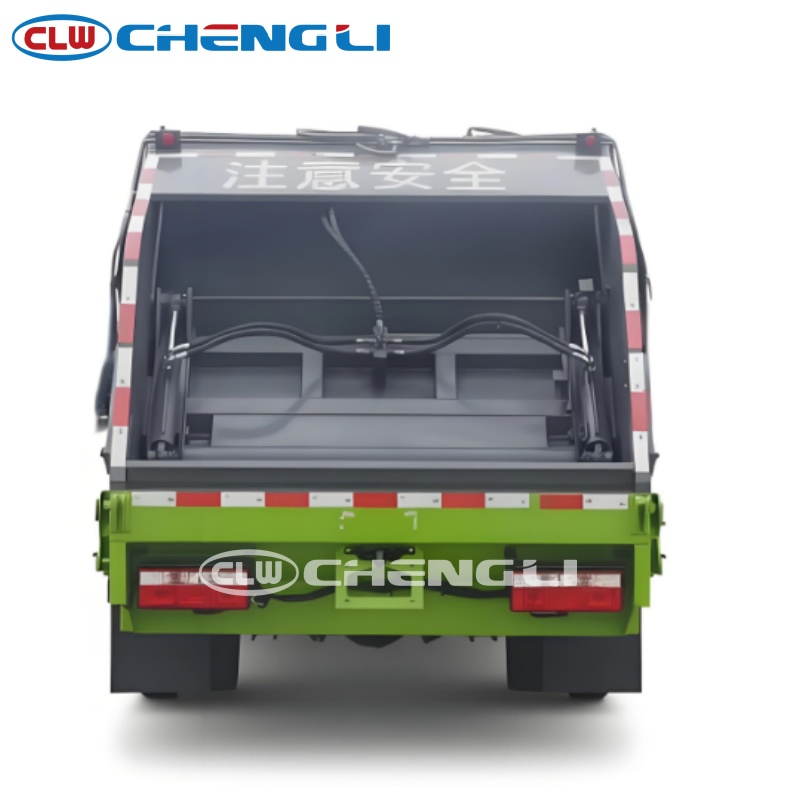
Ask where the compactor works
“Refuse compactor” can mean a collection truck, a fixed machine at a waste site or a transportable compaction container. All reduce the space occupied by suitable waste, but they sit at different points in the collection chain. The useful first question is whether the equipment must visit many collection points or receive waste at one location.
A truck-mounted compactor travels with its own chassis, loading equipment and refuse body. A stationary unit remains at the site and typically presses into a detachable transport container. A portable or self-contained unit integrates the press and container for transport together. Product terminology varies, so request a layout and describe the intended loading, storage and emptying process.
Compare the three operating arrangements
| Type | Where waste is loaded | What leaves for emptying | Main interface to define |
|---|---|---|---|
| Truck-mounted | Along a collection route | Complete collection vehicle | Bins, lifter and receiving facility |
| Stationary | At the installed collection point | Compatible detachable container | Press-to-container connection and carrier |
| Portable / self-contained | At the selected site | Integrated press-and-container assembly | Complete assembly and compatible carrier |
The table describes typical arrangements, not a specification for every machine. A movable compactor is not necessarily a road-going vehicle, and the word portable does not mean it can be lifted by any hook truck. Confirm the complete assembly's mass, dimensions, handling interface and securing arrangement with the equipment and transport providers.
Truck-mounted compaction for collection routes
A collection vehicle carries the packing system between stops. In a rear loader, suitable refuse enters the rear hopper and the packing mechanism moves it into the body. The vehicle then travels to the receiving facility for discharge. The main purchasing task is matching chassis, body, bins, crew working method and the route.
Review the CLW compactor truck family and the rear-loader range when the requirement is mobile collection. Body volume, permitted payload, axle loads, turning access and the time spent unloading all matter. Read how a truck compactor works for the loading and discharge sequence. A pressure figure alone does not define route productivity.
Stationary compaction at a fixed collection point
A stationary installation can receive suitable waste from a concentrated activity such as a distribution site or transfer operation. In the common detachable-container arrangement, the press remains while a loaded container is removed. Specify how waste reaches the feed opening and how container exchange will take place without obstructing the site.
The enquiry should cover the material, peak delivery pattern, feed opening, power supply, foundation or support requirements and carrier access. Confirm whether another compatible container is needed while the first is away. Storage space, vehicle circulation and the receiving facility's unloading method are part of the system, even though they are outside the press itself.
Portable does not mean universally transportable
In a self-contained arrangement, the pressing unit and storage container travel together for emptying. This can suit a collection point that requires an integrated assembly, provided the selected design is appropriate for the waste. For wet material, examine the actual containment and drainage arrangement rather than treating the word sealed as a complete specification.
Define the carrier interface using drawings. Hook height, pickup geometry, rails, rollers, locks, assembly length and loaded mass must work together. Include the press mass in the transported assembly. The hook lift truck family concerns carriers; it does not establish that every carrier accepts every compaction container or that every container configuration is available.
Compare throughput through the whole chain
A machine cycle time describes one operation, while daily throughput depends on feeding, interruptions, container availability and transport. For a truck, include collection stops, travel, queuing and discharge. For a site installation, include incoming peaks, exchange time and the interval before an empty container returns. Use the same waste stream and daily mass when comparing alternatives.
Do not directly compare a press's theoretical cubic metres per hour with a collection truck's body volume. One is a rate under defined conditions; the other is storage space. Neither establishes legal transported mass. Ask how the proposed equipment handles the actual material and evaluate the complete operating sequence, including the receiving facility and any additional handling.
Include people, guarding and maintenance access
Compaction equipment introduces moving machinery and often works near pedestrians or transport vehicles. Plan safe feeding, controlled access and separation from moving vehicles. The UK HSE's waste machinery guidance discusses suitable equipment, guarding, maintenance and training. Apply the requirements relevant to the destination; the guidance is not evidence of a particular machine's certification.
Ask for the actual operating instructions, isolation procedure, emergency-stop arrangement and maintenance access needs. Clearing an obstruction must not depend on entering a danger zone while machinery is active. Agree a practical demonstration of the supplied controls and handling process. Keep the operator's working space and service access in the layout instead of filling all available floor area with equipment.
Compare the scope behind the quotation
A truck quotation and a site-machine quotation can include very different items. Compare the complete truck, press, containers, carrier, installation work, electrical connection and transport scope as applicable. Identify which party supplies each interface. Also agree spare-parts scope and training arrangements for the selected equipment rather than assuming they are standard across systems.
For operating cost, compare collection labour, number of trips, site staffing, energy provision and maintenance against the same workload. A low machine price can leave a separate transport requirement unresolved. An integrated unit may simplify one interface while increasing transported equipment mass. These tradeoffs should be evaluated for the actual site instead of described as universal savings.
Write the requirement before selecting a machine
Start with waste type and daily mass or volume, then define collection locations, feeding method and the receiving facility. Add available space, power, operating hours, container fleet and transport distance. For a truck purchase, include route dimensions, quantity, destination and any driving-position requirement. LHD or RHD availability depends on the selected chassis and model.
CLW's vehicle enquiry should make clear whether you need a collection truck or a carrier within a wider site system. Request the exact equipment scope and compatible interfaces in the proposal. This keeps a search for “refuse compactor” connected to the equipment's actual job, without treating three different operating arrangements as interchangeable products.
Questions buyers ask
Is a portable compactor a garbage truck?
Not necessarily. A self-contained portable compactor is generally an integrated press-and-container assembly that needs a compatible carrier for transport.
What stays on site with a stationary compactor?
In the common detachable-container arrangement, the press remains while the compatible loaded container is transported for emptying.
Will any hook lift carry a compaction container?
No. Match the complete loaded assembly, hook geometry, rails, locks, dimensions and permitted masses with the selected carrier.
Can a pressure rating determine daily throughput?
No. Feeding, material, interruptions, container exchange and transport also determine the complete daily workload.