
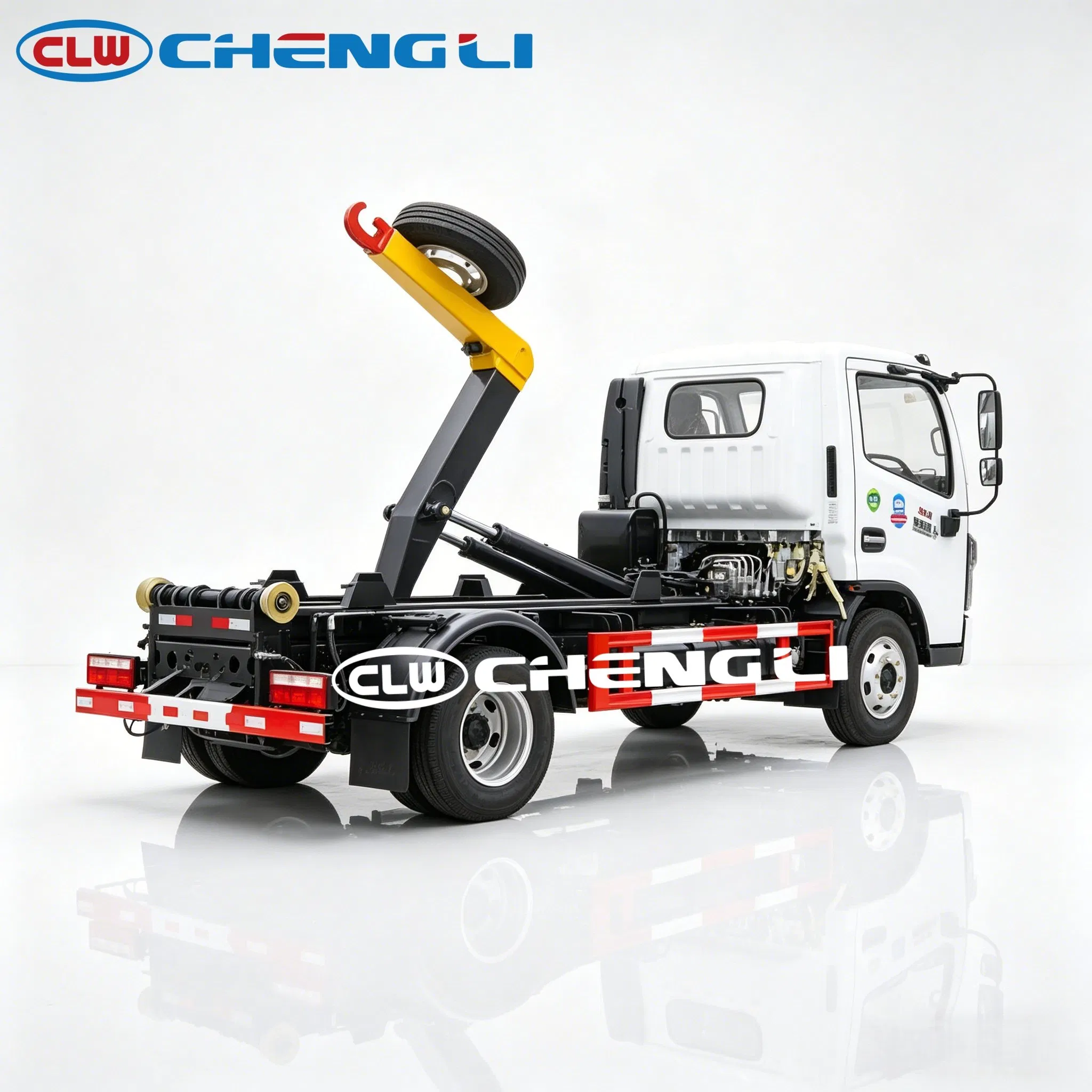
What does a hook loader do in a waste fleet?
A hook loader moves a compatible detachable container onto and off a truck chassis. The container can remain at a collection location while another matched container is transported. This separates the container's filling time from the truck's transport task, provided the fleet has suitable containers and a workable exchange plan.
It is a different collection method from emptying small bins into a permanently mounted compactor body. The CLW hook lift range is a starting point for specifying the carrier and matched containers. First define the load, exchange locations and unloading method rather than assuming every waste job needs the same vehicle.
Which parts perform the container handling?
The principal elements include a hooked lifting arm, hydraulic actuation, a supporting frame, rear guiding or rolling arrangements and container-securing equipment. The exact mechanism varies by design. Controls, movement limits and the compatible container geometry belong to the specified unit, not to the general name hook loader.
The hook engages the container's designed lifting point; the frame and rollers support the transfer and transport arrangement. Securing functions must correspond to the actual container and equipment. A raised hook in a photograph does not identify a lifting rating or establish that an arbitrary container will fit.
How does a typical container cycle work?
The table describes the broad mechanical stages for a buyer. It is not a control sequence for operating a particular machine. Trained operators need the supplied instructions, agreed working method and actual site conditions. Loading, container removal and tipping are distinct movements and should not be treated as interchangeable commands.
| Stage | Broad mechanical purpose | What the buyer should define |
|---|---|---|
| Position and prepare | Align the truck and container within the working area | Approach, ground, clearance and container condition |
| Engage the lifting point | Connect the hook to the designed container interface | Hook height, lifting point and compatible geometry |
| Transfer the container | Move the container over the rear guidance onto the frame | Container length, loaded mass and equipment capacity |
| Secure for transport | Retain the container in its specified travel position | Applicable locks and complete loaded configuration |
| Remove or tip | Place the container down, or tip where the unit is designed to do so | Separate operating envelopes and authorised functions |
Locking arrangements are equipment-specific. For an example of how a manufacturer distinguishes hook, frame and container securing functions, see the MULTILIFT operator manual. Those details apply to its named equipment and are not specifications for a CLW proposal.
Why is hook height important?
The height and geometry of the container's lifting point must suit the hook arrangement. A container can have the desired cubic capacity yet the wrong interface. The buyer therefore needs a dimensioned container drawing, not merely a photograph or a statement that the container holds a certain number of cubic metres.
Use the hook lift and skip container compatibility guide for the detailed matching discussion. Identify how dimensions are measured and which container revision is being offered. Do not force an apparently similar lifting point to fit or assume one hook height is universal across every size of equipment.
What else must match besides the hook?
Check container length, supporting frame or rails, rear rolling arrangement, securing positions and the complete loaded travel condition. Review how the container is supported during transfer and transport. Compatibility is an equipment-and-container combination; it cannot be established by comparing external bin volume alone.
Existing containers should be identified and measured individually. Changes in lifting points, rails or locks need a properly specified compatibility assessment. The carrier's chassis and mounting also matter, so use the chassis and body matching guide to connect the handling system to the complete vehicle.
Does lifting capacity equal the permitted waste payload?
No. The handled container includes its own mass as well as its contents. Equipment capacity and the complete truck's gross, axle and payload limits are separate constraints. A lifting-capacity label does not create permission to carry the same mass of waste on any chassis.
Specify the loaded container mass and its distribution, then compare the equipment and chassis limits for the actual geometry. Include the container's empty mass and any other carried items according to the adopted definitions. A larger container may add volume without increasing the permissible load or the suitable lifting range.
When is container exchange useful?
Consider it where a suitable container can be filled at a site and collected as a unit. The fleet plan must allow space to leave and exchange containers, provide compatible equipment and connect the task to the receiving facility. The appropriate waste and container design still need to be defined for the duty.
Compare the roll-off and hook lift guide and the RoRo bin lorry guide when interpreting different market terms. The name alone does not tell you whether a proposal uses a hook, cable or another container-handling arrangement.
Which site conditions belong in the proposal?
Describe access, ground conditions, overhead obstructions, the area behind the truck and the interaction with other people or vehicles. Container exchange and tipping may require different spaces. Establish the operating envelope and site requirements with the equipment instructions and the intended working method.
The UK HSE waste-transport guidance highlights route assessment, pedestrian separation and reducing reversing. Use those considerations when planning the site; do not substitute a sales description for the operating instructions and training appropriate to the actual equipment.
How should LHD, RHD and working controls be specified?
State the destination, driving position and intended operator and collection side. A hook lift is a complete working arrangement, not simply a cab with a steering wheel on one side. Visibility, access and the control layout should be discussed with the intended container-exchange locations.
The full RHD build guide and LHD/RHD buyer guide set out related questions. Agree the configuration and supporting information for the actual destination. A steering-side label alone does not establish road approval or suitability for every working layout.
What should you send CLW for a hook loader quotation?
Send the destination, truck quantity, waste description, loaded container mass and container drawings. Include hook height, container length, rails, rollers and securing details, along with route restrictions and the unloading method. State whether containers already exist and which chassis or driving arrangement is required.
Request a matched hook lift truck proposal. Ask for the complete vehicle and handling-equipment scope, compatible container range and relevant operating documentation. Comparing those items together helps turn a general request for a hook loader into a defined garbage-transport vehicle purchase.
Questions buyers ask
Is a hook loader a general-purpose lifting crane?
No. It handles compatible containers through a designed hook, support and securing arrangement. Its name does not authorise lifting unrelated objects or using improvised lifting points.
Will every container with the same volume fit the truck?
No. Hook height, container length, supporting geometry, rollers and locking positions must match the specified equipment. Provide drawings and identify the actual container.
Does the container’s own weight count in the load?
Yes. The container and its contents are handled and carried together. Check equipment capacity plus the complete truck’s gross, axle and payload limits for the actual configuration.
Does a hook lift compact waste while collecting it?
The hook mechanism handles the container; it is not itself a waste-packing system. Any compaction function would require separately specified equipment and should not be assumed from the hook lift name.