Remote-control arrangement
Remote controls support operation beside the vehicle.
Controls must be used with safe visibility and the operating sequence.

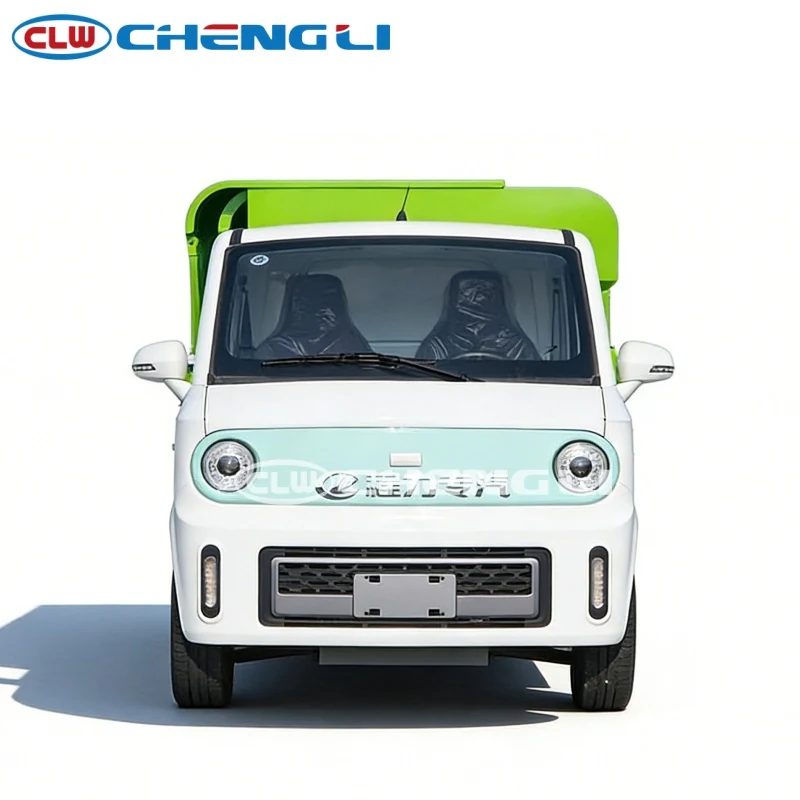
CLW / Self-Loading Garbage Truck
This CLW self-loading garbage truck lifts compatible refuse bins into its body for collection and local transfer. It suits residential neighborhoods, campuses and market routes where repeated bin emptying is part of the daily duty cycle. Vehicle access, bin geometry and waste mass guide the collection plan.
CLW / Operation
| Vehicle detail | What it means for your route | Planning conditions | What affects the result |
|---|---|---|---|
| 5 m³ | Body volume helps plan the waste space available for each trip. | Use the selected body and loading arrangement. | Waste density, moisture and permitted mass determine the actual load. |
| 1650 mm | Vehicle width supports access planning at collection points. | Compare with the narrowest usable opening along the route. | Mirrors, obstacles, turns and loading clearance need additional space. |
| 20.72 kWh | Battery energy is an input for the daily duty and charging plan. | Set route distance, working hours and charging windows together. | Payload, speed, auxiliary equipment, temperature and charging power affect the plan. |
| ≤ 60 s | Equipment cycle time helps plan a loading or unloading stop. | Allow for vehicle positioning and the complete operating sequence. | Bin handling, waiting, waste characteristics and travel also determine route output. |
CLW / Overview
Use this vehicle as part of a collection plan built around repeated bin collection in residential areas. Hydraulic bin lifting for self-loading collection. The loading area and collection-point layout determine how the vehicle is positioned during each stop.
Choose the vehicle around the actual route, collection interface and daily duty cycle. Share your waste type, operating hours and destination with CLW so the chassis, collection equipment and delivery batches can be specified together.
CLW /
| Container capacity | 5 m³ |
|---|---|
| Vehicle width | 1650 mm |
| Load capacity | 415 kg |
| Drive layout | 4×2 |
| Manufacturer | CLW |
| Fuel type | Electric |
| Transmission | Automatic |
| Wheelbase | 2600 mm |
| Gross vehicle weight | 1700 kg |
| Vehicle length | 4260 mm |
| Vehicle height | 1970 mm |
| Overall dimensions / configuration options | 4260 × 1650 × 1970 mm |
|---|---|
| Wheelbase | 2600 mm |
| Tyres | 165/70R13 |
| Seats | 2 |
| Battery energy | 20.72 kWh |
| Drive motor power | 20 kw |
| Battery chemistry | LFP |
| Waste body volume | 5 m³ |
|---|---|
| Collection system | Hydraulic bin lifting for self-loading collection |
| Bin interface | 120 / 240 L |
| Discharge cycle | ≤ 60 s |
|---|---|
| Driving range; route and load dependent | 160 km |
Bin sizes: 120 / 240 L. Provide bin dimensions, pickup points and loaded mass so the lifting interface can be matched to the collection system.
Remote controls support operation beside the vehicle.
Controls must be used with safe visibility and the operating sequence.
Vehicle colour and branding can be specified for the fleet.
Provide colour references and logo artwork with the order.
CLW / Your fleet order
The unit price depends on vehicle configuration and order quantity. The quotation sets out included equipment, trade terms, transport scope and the delivery plan.
Chassis, collection body and the equipment specified for the order
Tiered unit prices for the agreed fleet quantity
Destination, transport scope and phased delivery schedule
CLW / Factory & support
Factory visits can be arranged. Photos and videos before delivery help you check the agreed vehicle configuration.
Repeated bin collection in residential areas; Campus and property-management collection; Local waste transfer routes.
The waste body volume is 5 m³. Waste density and the permitted vehicle and axle loads determine the usable waste mass.
Tiered pricing: the more vehicles you order, the lower the unit price. Request the quantity-based quotation for your fleet. Large orders can be delivered in phases.
The minimum order is 1 vehicle. Provide the fleet quantity and destination for the quotation.
Send the waste type, daily duty, collection interface, delivery destination and order quantity. The unit price depends on vehicle configuration and order quantity. The quotation sets out included equipment, trade terms, transport scope and the delivery plan.
CLW / Vehicle selection
Compare each vehicle’s specifications and collection equipment for your operating requirements.
CLW /
Start with the truck, quantity and destination. Add configuration details if you know them.
[email protected]